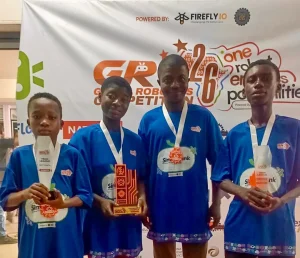
The Swedru Salvation Army School for the Deaf has made a strong statement for special education in Ghana, clinching third place in the Tech League at the Ghana Robotics Competition 2026, held at the University of Ghana on October 8 and 9.
Overcoming intense competition from mainstream basic and second-cycle schools nationwide, the talented Deaf robotics team did not just secure a podium finish – they swept two top-tier awards: the Best Coach Award and the Controller Conquest Award.
The feat stands as a powerful testament to the fact that hearing disability is no barrier to mastering Science, Technology, Engineering and Mathematics (STEM) when equal access, proper mentorship and resources are provided.
For a special school dedicated to educating Deaf children, taking part in a national robotics contest goes far beyond winning trophies.
It is an assertive declaration of capability, proving that Deaf learners possess the intellectual rigour, technical creativity and problem-solving grit required to thrive in a digital-first world.
Throughout the two-day competition, the Swedru team demonstrated advanced proficiency in robot design, mechanical assembly, algorithms and real-time controller programming.
Beyond coding, the experience equipped the learners with essential 21st-century skills, including critical thinking, complex problem-solving, strategic communication and high-pressure teamwork.
While securing 3rd place in the Tech League placed the school among the elite robotics innovators in Ghana, the two specialised awards underscored the holistic excellence of their preparation:
- 3rd Place (Tech League): Awarded for overall robot performance, engineering precision and game strategy execution on the national stage.
- Best Coach Award: Recognising exceptional technical instruction, pedagogical adaptation and transformative mentorship provided to the learners throughout their preparation.
- Controller Conquest Award: Celebrating the team’s technical mastery, speed and tactical superiority in the controller-driven challenge category.
Together, these accolades highlight how effective coaching and adaptive teaching methodologies can unlock the full potential of learners with sensory disabilities.
This milestone sends a clear message to policymakers, corporate entities and educators across Ghana: the Deaf child is fully capable when given the right tools and platform.
Educational advocates have noted that inclusion must move beyond merely allowing persons with disabilities to be present in rooms; it requires intentionally creating the structural conditions – accessible STEM laboratories, sign-language-integrated tech curricula, and adaptive assistive technology – that enable them to compete and win.
The school’s historic performance was made possible through key corporate and civil society partnerships.
Special appreciation was extended to Sintex Tank Ghana for providing primary corporate sponsorship, and DeafCanTalk for their vital technical and logistical support in making the team’s participation a reality.
The school administration also commended the tireless efforts of the coaching staff, teachers, school leadership, and parents whose unwavering encouragement sustained the learners throughout their training.
Above all, national praise goes to the young, brilliant Deaf robotics team members. Through their discipline, resilience and brilliance, they have rewritten the narrative surrounding Deaf education in Ghana, proving that when opportunity meets nurtured talent, excellence is inevitable.
This third-place finish and double award win mark the beginning of a larger movement toward inclusive digital education in Ghana.
With expanded access to advanced robotics kits, coding bootcamps, corporate sponsorships and industry mentorship, Deaf learners across Ghana can continue to engineer solutions to real-world national problems.
It is hoped that this monumental triumph will inspire the Ministry of Education, Ghana Education Service (GES), and private sector leaders to invest heavily in modernising STEM infrastructure across all special schools in the country.
SOURCE: DisabilityNewsGH.com