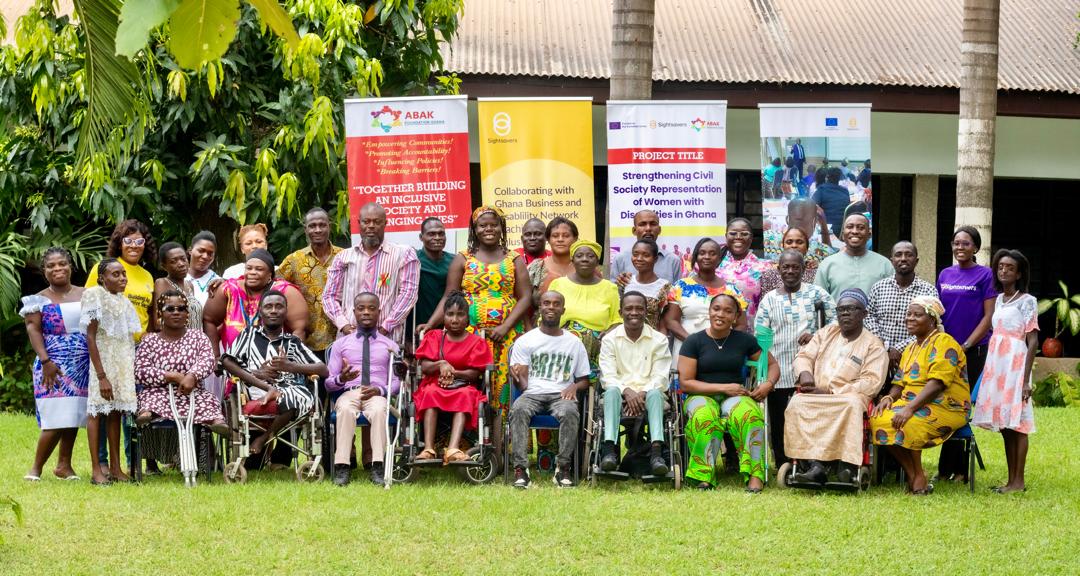
The ABAK Foundation Ghana, a national non-governmental organisation dedicated to disability inclusion, has launched a significant capacity-building project aimed at empowering 560 persons with disabilities across 20 districts in Ghana. This impactful initiative is a collaborative effort with Sightsavers and is generously funded by the European Union.
Philip Duah, Executive Director of ABAK Foundation Ghana, explained that the project strengthens the capacity of ABAK Foundation to then train its network of grassroots organisations. “This project has been very impactful. Sightsavers has strengthened the capacity of ABAK Foundation Ghana to also train downstream organisations within ABAK foundation’s network,” Duah stated.
The training targets participants in the Greater Accra, Bono, Bono East, and Ashanti regions. In the Greater Accra Region alone, 50 participants underwent training across two locations: Cantoments and Ningo Prampram, from October 27 to 30, 2025.
The comprehensive project focuses on four key pillars: disability inclusion, safeguarding, gender mainstreaming, and climate change.
Addressing Climate Change and Disability:
Duah highlighted the critical link between climate change and disability. “Climate change has a direct impact on persons with disabilities,” he emphasised. The training equips participants with knowledge on how to adapt to climate change and what actions to take during disasters.
“We need to advocate at the district level for authorities to know that anytime there’s a disaster, persons with disabilities are mostly affected and therefore they should be given needed attention,” Duah added, stressing the project’s aim to build advocacy capacity within local organisations on climate change.
Promoting Disability Inclusion and Participation:
A core aspect of the training is enhancing disability inclusion, particularly focusing on the participation of women with disabilities in decision-making at all levels. Duah pointed out the existing gaps:
“In most of the local assemblies, persons with disabilities are not given opportunity to also take part in decision making processes within the local governance process.” The project serves as a call to government and civil society to intensify advocacy efforts to ensure persons with disabilities are included in local governance structures.
The initiative also examines barriers to access within churches and communities, including access to land, social services, and healthcare, identifying opportunities for women with disabilities. “These are the things we are looking at when we are talking about including persons with disabilities, especially women with disabilities in all the aspects of our community life that we are enjoying,” Duah explained.
Ensuring Safeguarding and Ethical Practices:
The safeguarding component focuses on ensuring that the work conducted by civil society organisations, including trainings and community programmes, does not inadvertently cause harm to anyone.
“We are looking at a safeguarding checklist. What are some of the things we should know in case you’re organising an event; what do you have to do to ensure that your programmes and activities become more accessible to everybody and then you do not cause harm to other people,” Duah detailed, underscoring the commitment to protect the very people they serve.
Advancing Gender Mainstreaming:
Finally, the project addresses gender mainstreaming, striving for equal representation of both women and men, particularly women with disabilities, in leadership and decision-making roles.
“Let’s look at our district assembly structure, let’s look at some of the structures that are formed by the traditional leaders in our communities – how many women are involved and even how many of these women are women with disabilities?” Duah questioned, highlighting the project’s dedication to championing this critical area.
Through this comprehensive capacity-building project, ABAK Foundation Ghana, in partnership with Sightsavers and the European Union, is laying the groundwork for stronger, more inclusive, and more resilient communities for persons with disabilities across Ghana.
SOURCE: DisabilityNewsGH.com

Is on social media that I saw it , and i deem it necessary to be part of the program
Am glad to be part of it, and I promise to abide by the rules and regulations