An investigation by DisabilityNewsGH.com has exposed severe financial irregularities, illegal tax deductions, and a history of political interference in the management of the Persons with Disabilities (PWD) Common Fund by the Ashaiman Municipal Assembly (ASHMA) in the Greater Accra Region.
The investigation centres on the case of Mr Anthony Kwaku Appiah, a graphic designer with a disability who operates a printing business in Ashaiman-Lebanon.
Mr Appiah has been left stranded and financially ruined after assembly officials procured a light-duty desktop printer instead of the commercial equipment officially approved for him, while failing to account for a GH₵2,700 budget balance.
The Disparity: Approved GH₵5,000 vs Procured GH₵2,300
Somewhere last year, Mr Appiah applied for support under the PWD Common Fund to acquire a specific working tool: a mini heavy-duty foreign-used commercial printer valued at GH₵4,500 to handle high-volume printing.
After vetting, the Ashaiman Disability Fund Management Committee (FMC) officially approved and budgeted GH₵5,000 for his allocation.
However, instead of disbursing the cash or procuring the requested commercial machine, the Assembly unilaterally purchased an EPSON Ecotank L3251 – a light-duty desktop printer designed for home and small-office use.
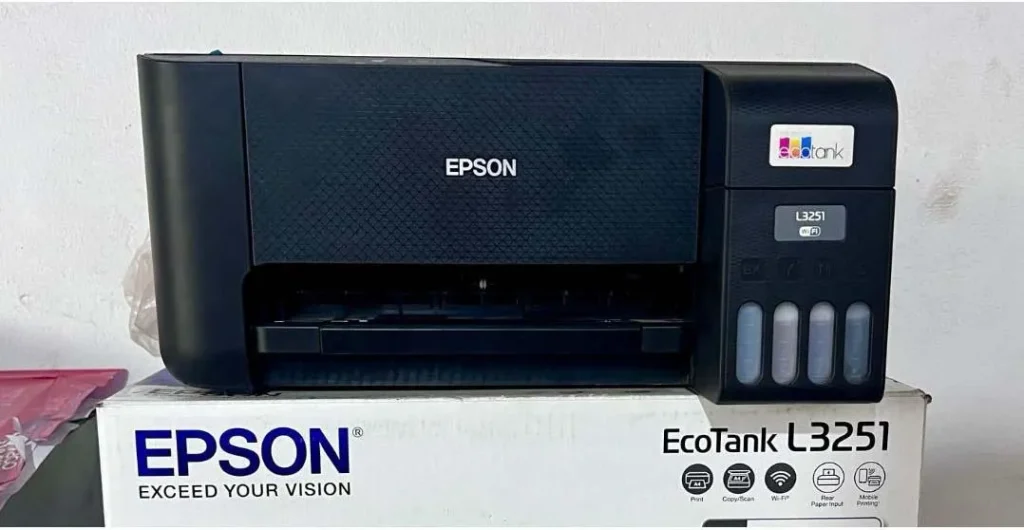
Photo Description: The EPSON Ecotank L3251 printer
Investigations by DisabilityNewsGH.com revealed that the Assembly acquired the desktop printer at a cost of GH₵2,300.
When the machine was formally presented to Mr Appiah on Thursday, May 8, 2026, the remaining balance of GH₵2,700 was withheld. No refund, explanation or official account of the missing funds was provided to the beneficiary.
Unfit Equipment, Expired Warranties, and Lost Livelihood
The operational consequences for Mr Appiah’s business were immediate and devastating:
1. Unfit for Commercial Use: The small desktop printer was entirely incapable of handling commercial printing workloads, crippling his daily business operations.
2. Breakdown Within Eight Weeks: Less than two months after receipt, the machine suffered a total mechanical failure.
3. The Expired Warranty Trap: When Mr Appiah reported the breakdown to the Assembly to seek repairs or replacement, officials dismissed him, claiming: “We had only a one-month warranty, and it has been more than a month since we bought it.”
Further checks revealed that the Assembly purchased the printer weeks before physically handing it over to Mr Appiah, allowing the short warranty period to lapse while the machine sat in the assembly’s storage.
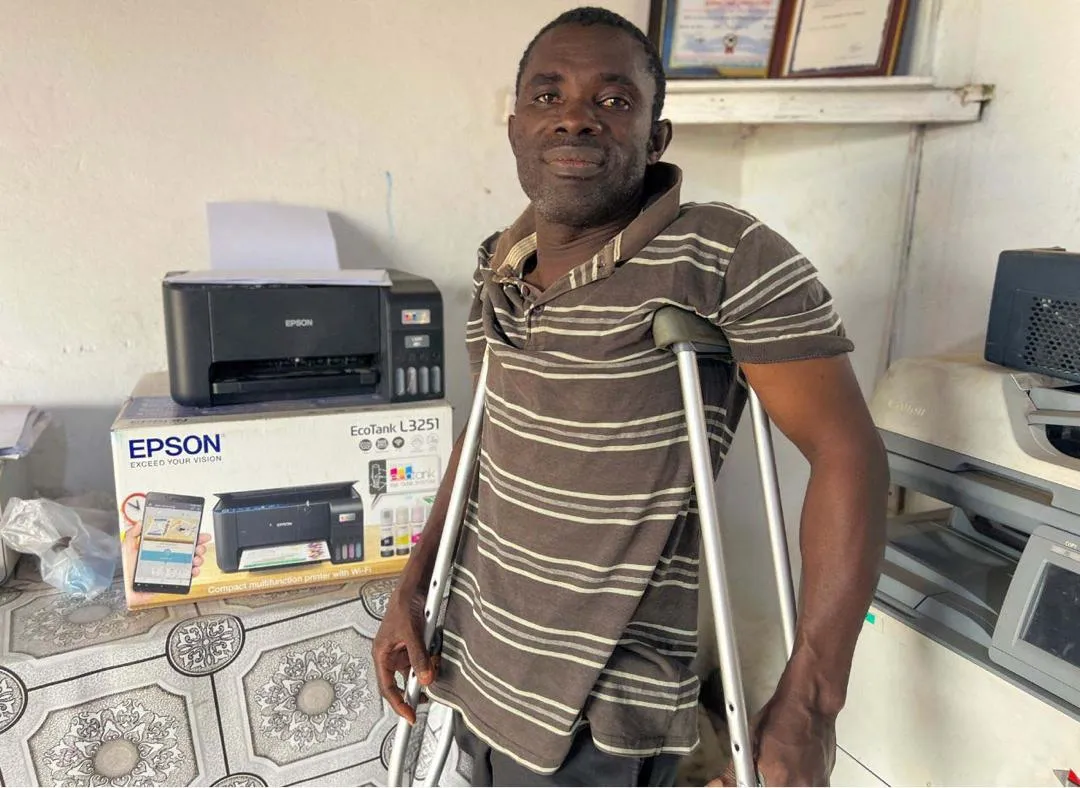
Photo Description: Mr Anthony Kwaku Appiah standing by the printer, supported by two crutches
Exposing ASHMA’s Systematic and Illegal Tax Deduction Practice
Confronted with the findings, key stakeholders offered conflicting explanations that uncovered a much broader systemic issue within the Ashaiman Municipal Assembly:
• Social Welfare Director Denies Budget Knowledge: The Municipal Social Welfare Director, Madam Vida Adjumani – who serves as Secretary to the FMC, denied knowing how much was budgeted for Mr Appiah, despite having co-prepared and signed off on the official budget.
• FMC Chairman Confirms Budget, Reveals Systematic Taxing: The Chairman of the FMC, Mr Joshua Addi – a representative of the National Council on Persons with Disability (NCPD) serving as Committee Chair – confirmed that GH₵5,000 was indeed budgeted for Mr Appiah.
He claimed, however, that he had no idea how much the Assembly’s Procurement Officer actually paid for the printer.
DisabilityNewsGH.com can confirm that shortchanging beneficiaries through “tax deductions” is a general routine practice applied by ASHMA across its PWD Common Fund procurements and disbursements, rather than an isolated occurrence for Mr Appiah.
Why ASHMA’s Municipal-Wide “Taxing” Is Strictly Illegal:
An analysis of Ghanaian tax laws and District Assemblies Common Fund (DACF) guidelines confirms that ASHMA’s widespread practice of deducting taxes from PWD allocations violates statutory regulations:
1. PWD Grants Are Non-Taxable: Statutory transfers from the DACF to PWDs under Article 252 of the 1992 Constitution are social protection grants. They are not income or revenue, and are strictly non-taxable under Ghana Revenue Authority (GRA) regulations.
2. Vendor Taxes Must Not Be Deducted from Beneficiaries: While public procurement regulations require Assemblies to withhold 3% Withholding Tax (WHT) when paying commercial suppliers, that tax comes out of the vendor’s profit margin – it can never be deducted from a PWD beneficiary’s approved grant or item value. Assemblies are required to budget VAT-inclusive prices without reducing the beneficiary’s allocation.
3. Absurd Deduction Rates: Even if statutory taxes were legally applicable, no tax framework in Ghana justifies consuming 54% (GH₵2,700 out of GH₵5,000) of an approved public allocation.
The FMC Chairman stated that his only administrative remedy is to recommend Mr Appiah for a replacement printer following an upcoming monitoring exercise, leaving the graphic designer stranded without equipment while losing his client base.
The case highlights a wasteful cycle: public funds are squandered on inappropriate equipment, thousands of Ghana Cedis remain unaccounted for across multiple disbursements, and additional taxpayers’ money will be needed to replace mistakes that were entirely preventable.
A History of Mismanagement and Political Interference
Research by DisabilityNewsGH.com reveals that this is not the first time the Ashaiman Municipal Assembly has been embroiled in controversies regarding the Disability Fund.
The recent May 8, 2026 disbursement was delayed for eight months due to an administrative standoff between the Municipal Chief Executive (MCE), Hon. Freeman Tsekpo, and the Fund Management Committee.
Following his appointment after the committee had already vetted and approved the list of beneficiaries in September 2025, the MCE refused to sign the disbursement memo.
He demanded that 10 vetted and approved PWD applicants be removed from the list and replaced with individuals of his own choice, stating he would not approve a list he was not personally involved in compiling.
The impasse dragged on from September until December 2025, when the matter was eventually reported to a state investigator.
Although the memo was signed following investigator’s intervention, administrative delays pushed the actual disbursement to May 8, 2026, leaving beneficiaries waiting for nearly a year.
Call for National Audit
The ordeal of Mr Anthony Kwaku Appiah exposes a wider pattern where the PWD Common Fund – 3%, now increased to 5% of the DACF – is treated by Assembly officials as a cash cow through routine tax deductions, procurement inflation, distribution of substandard goods, and illegal withholdings.
DisabilityNewsGH.com calls on the Ministry of Local Government, Chieftaincy and Religious Affairs, the Auditor General, the Administrator of the District Assemblies Common Fund, Economic and Organised Crime Office (EOCO), and the Office of the Special Prosecutor (OSP) to launch an immediate forensic audit into the Ashaiman Municipal Assembly’s Disability Fund accounts and hold offending officials accountable.
DisabilityNewsGH.com