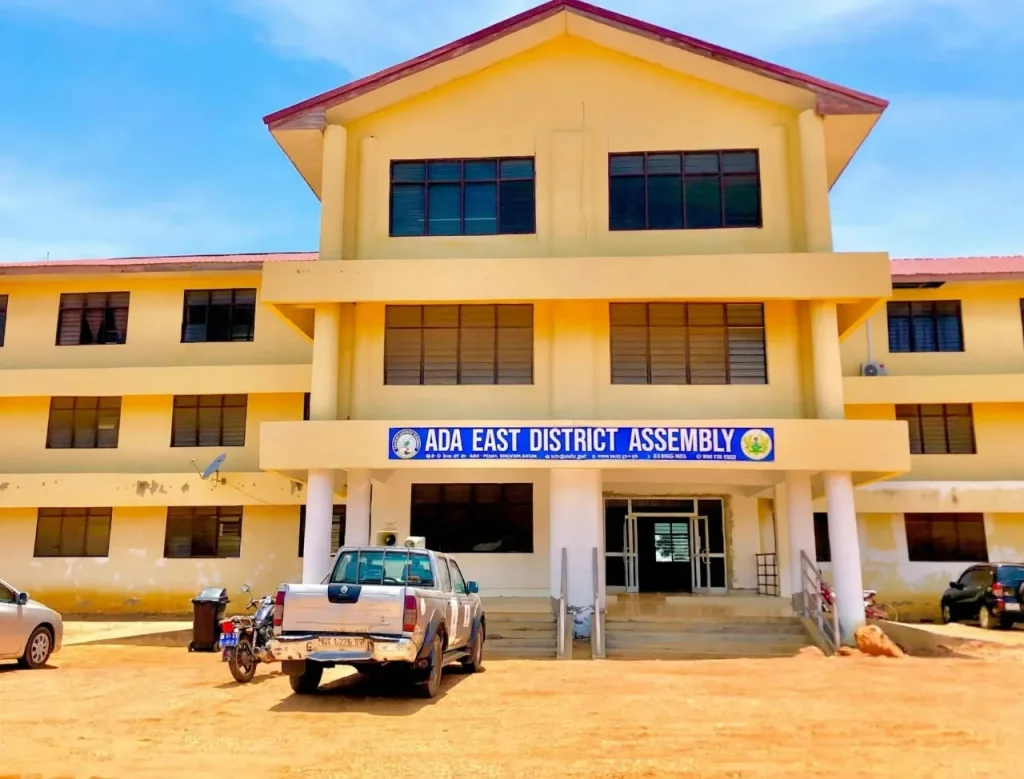
The Final Report on the probe into the December 2025 disbursement of the 3% Disability Fund in the Ada East District, commissioned by the General Assembly, has been diverted by the Presiding Member to the Fund Management Committee for implementation, sparking revolt from the disability community.
Information available to DisabilityNewsGH.com indicates that the Presiding Member, Hon. Philip Tetteh Atchia, on the instructions of the Assembly Administration, transmitted the report directly to the Fund Management Committee on Wednesday, September 30, 2026.
He instructed the committee to hold an emergency meeting on October 1 and 2, to consider and implement the recommendations.
This action directly flouts Section 11.0 of the report itself, which explicitly states that it is “respectfully submitted to the Ada East District Assembly for consideration and appropriate action.”
CHRONOLOGY OF THE PROBE
- December, 23, 2025: Disputed disbursement of 3% Disability Fund
- December 30, 2025: General Assembly orders probe
- July 31, 2026 (Friday): Assembly debates Initial Report, orders Further Investigation
- August 6, 2026 (Thursday): Further sittings held with beneficiaries
- Sept 30, 2026 (Wednesday): Final Report diverted to FMC instead of General Assembly
The Legal Breach
The diversion violates the Local Governance Act, 2016 (Act 936) and the Model Standing Orders.
Act 936, Section 25: A District Assembly may establish committees as it considers fit. Every committee shall report its proceedings to the District Assembly and decisions shall be subject to approval of the Assembly.
Model Standing Orders, Order 34(3):
“The report of an ad hoc committee shall be submitted directly to the General Assembly for consideration and appropriate action. It shall not be altered, amended or implemented by any other committee, officer or authority other than the General Assembly.”
Internal Dissent: Committee Secretary Expresses Shock
When DisabilityNewsGH contacted the Secretary Hon. John A. Kubi, who signed the report for Chairman Hon. Moses Wussah, he expressed utter surprise.
He wondered how a report meant strictly for the General House found its way to the Fund Management Committee.
Hon. Kubi insisted the binding decision was for the report to be presented to the General Assembly at an emergency meeting.
When contacted, the Presiding Member confirmed the transmission.
Hon. Atchia, who was originally not a member, volunteered during the second ordinary sitting on July 31, 2026, to join and to personally fund the sittings after the Assembly Administration failed to fund initial work.
Hon. Atchia told DisabilityNewsGH that the Administration cited the cost of convening the Assembly as the reason for diverting the report directly to the FMC, claiming it would cost not less than GH₵30,000.
What The Final Report Hides: From Resignation To Reconciliation
To appreciate the gravity of the diversion, one must examine the proceedings of the General Assembly’s ordinary sitting on July 31, 2026.
During that session, the House briefly debated the initial report submitted by Hon. Moses Wussah’s committee.
That initial report was damning: it detailed how cash grants were cancelled, established based on the testimony of the District Social Welfare Officer that the District Co-ordinating Director, Madam Jane Ameley Tagoe, had directed that items be bought because beneficiaries would “mismanage the funds.”
It also showed the Procurement Officer boycotted invitations, and concluded unequivocally that “no valid disbursement was made,” recommending the immediate resignation of the Social Welfare Director, Mr Enock Addy.
However, during the July 31 debate, the General Assembly noted that critical individuals cited in the report, specifically the Co-ordinating Director and the Procurement Officer, had not testified before the committee.
To ensure natural justice, establish a comprehensive record, and prevent any implicated official from escaping accountability through procedural loopholes, the House directed that a “further investigation” be conducted.
The committee was explicitly mandated to summon these key administrative heads alongside the 24 affected beneficiaries.
The further sittings took place as directed by the General Assembly.
But DisabilityNewsGH can confirm that the order was never carried out. The Co-ordinating Director and the Procurement Officer were not invited to testify before the further investigation.
Instead of scheduling the report to be laid before the House, the Presiding Member went into closed-door discussions with the Assembly Administration, where the findings were substantially rewritten:
• Core Finding Reversed: The core finding of the initial investigation, that no legitimate disbursement was done, has been completely discarded in the final report on the grounds that it was “too categorical.”
To justify the reversal, the language of certainty has been systematically replaced with the language of doubt.
The word “reportedly”, which did not appear in the initial damning report, now appears 13 times in the final document.
What the first investigators established as fact based on direct testimony is now presented in the final report as mere allegation.
• Figures Quietly Altered: A comparative analysis by DisabilityNewsGH of the figures contained in the First Report of the Further Investigation and the Final Report reveals that key financial figures for top-ups were quietly altered without any explanation or justification.
For beneficiary Moses Obitsrey Agudey, the amount recorded as GH₵1,000 in the First Report of the Further Investigation has been reduced to GH₵500 in the Final Report.
For Caleb Akuaku, the figure has shifted from GH₵2,400 to GH₵2,280, and for Cecilia Puplampu, from GH₵2,100 to GH₵1,920. No appendix, footnote, or paragraph in the final report explains why these figures changed, who authorised the change, or what new evidence justified it.
• Top Brass Shielded: The Co-ordinating Director and the Procurement Officer were completely excused from further scrutiny, with neither facing administrative sanctions or formal queries in the final document.
• Sanctions Erased: The most telling evidence of the diversion is the systematic erasure of sanctions. In December 2025, the Initial Report recommended that the Social Welfare Director, Mr Enock Addy, must resign.
In August 2026, the First Report of the Further Investigation softened this to a requirement that he must apologise at the General Assembly and in the media.
By September 2026, the Final Report is completely silent on any personal sanction. The recommendation demanding resignation and a public apology has been completely expunged and replaced with a generic, non-punitive call in Recommendation 10.10 for Management to “review administrative processes”.
The individual accountability that the House demanded has been dissolved into institutional jargon.
The Ultimate Conflict of Interest
Recommendation 10.5 tasks District Stores Unit, in collaboration with Social Welfare Department headed by Mr Addy himself, to conduct stock-taking. Recommendation 10.10 asks Management led by Madam Tagoe to propose sanctions.
This is the equivalent of a thief being caught breaking into a bank, and instead of calling police, the judge tells the thief: “Go back into vault, investigate how much you stole, write your own report, and decide punishment.”
The two principal accused persons have now been tasked to investigate themselves and to propose punishment for their own actions.
Linguistic Footprints: Exposing Who Wrote the Final Report
Perhaps the most telling evidence of administrative influence lies in the very language, grammar, and syntax of the documents.
A comparative reading of the three reports in the possession of DisabilityNewsGH shows a striking shift that raises serious questions about who controlled the final draft.
The Initial Report and the First Report on Further Investigation are written in the direct, people-centred language consistent with elected assembly members.
They prioritise facts and beneficiary voices, quoting persons with disabilities verbatim and stating findings plainly in active phrasing:
- “He requested to trade and an amount of 3,000.00 was approved for him but he received fresh Okra…”
- “She was given a carton of spoiled frozen fish…”
- “That no legitimate disbursement was done.”
However, the Final Report undergoes a sudden, dramatic stylistic shift. It is written in highly polished, sterile, and defensive bureaucratic prose consistent with administrative memos.
The active, truth-seeking voice of the earlier reports is replaced by passive, legalistic wording:
- Instead of raw beneficiary quotes, the text shifts to: “Mr. Caleb Akuaku indicated that he applied for support to undertake trading activities…”
- It uses complex administrative phrasing: “It would therefore be administratively inappropriate to conclusively determine the exact outstanding entitlement…”
- Most notably, the final report includes paragraphs written from the perspective of the administration under probe, such as claiming that “officers from the department of social welfare… stated that individual beneficiaries were called to indicate the type of items they wanted.”
This drastic shift in grammar and writing style raises the fundamental question of authorship. The documents in our possession suggest the final draft bears the imprint of the very administration under investigation, with culpability repackaged in passive, bureaucratic prose.
The GH₵30,000 Excuse and Two Reports Limbo
The Presiding Member argues that an assembly session costs GH₵30,000. But was cost not considered when the General Assembly resolved on December 30, 2025 to probe? Why was cost not raised on the floor for members to determine alternatives, rather than deciding quietly after the work was done?
The Assembly now finds itself with two unclosed reports carrying conflicting directives.
The initial report ordered a fresh disbursement by March 2026, while the Final Report orders completion by September 15, 2026. The General Assembly has formally adopted neither.
A glaring documentary discrepancy also caps the scandal: the cover letter forwarding the report to the District Chief Executive is dated March 30, 2026, yet the body of the report records beneficiary hearings taking place months later on August 6, 2026.
DisabilityNewsGH is in possession of the Initial Report, the First Report of the Further Investigation, and the Final Report, including the March 30 cover letter. We will make these documents available to oversight bodies upon request.
DisabilityNewsGH therefore calls on the Ministry of Local Government, Chieftaincy and Religious Affairs and the Auditor-General to launch an independent forensic inquiry into Ada East District Assembly’s handling of the PWD Common Fund.
SOURCE: DisabilityNewsGH.com