The presidential assent of the Legal Education Act, 2026 (Act 1170) marks a systemic shift in the democratic and institutional architecture of Ghana’s legal system. For nearly seven decades, professional legal education in this country was bottlenecked by a rigid, over-centralised monopoly, legacy-anchored to the Ghana School of Law under the old Legal Profession Act, 1960 (Act 32).
Act 1170 completely dismantles this historical gatekeeping. By establishing the Council for Legal Education and Training (CLET), shifting professional law practice training to accredited universities across the country, and instituting a unified National Bar Examination, the new law boldly prioritises access alongside standards. Yet, as our legal community celebrates this decentralised innovation, an uncomfortable, existential question remains unaddressed: Access for whom?
If the current conversation surrounding legal education reform focuses entirely on expanding the quantity of lecture halls without interrogating who can physically and intellectually cross their thresholds, we fail the ultimate test of constitutional justice.
Legal education is not a mere technical trade; it is the crucible where the defense of human rights begins.
If our law faculties systematically marginalise or ignore persons with disabilities (PWDs), we train future lawyers, judges, and policymakers in an environment that treats equality as an abstract classroom theory rather than an enforceable, living reality.
True, holistic legal reform requires that disability rights sit at the dead centre of our implementation strategies.
The Statutory Innovation of Section 47
The drafters of Act 1170 deserve immense commendation for explicitly codifying disability provisions into the text of the law. Historically, our legal education system treated disability through the condescending lens of administrative charity or ad-hoc benevolence.
Act 1170 radically alters this paradigm by dedicating explicit statutory text under Sections 46 and 47 to non-discrimination and the provision of reasonable accommodation for persons with disabilities.
Through this, Parliament has sent an unambiguous signal: inclusivity is no longer an optional institutional luxury; it is a mandatory statutory obligation.
To ensure that this statutory innovation is not diluted during its implementation phase, a rigorous, clinical legal reading of Section 47 is urgently required.
Non-Discriminatory Access (Clause 1)
Section 47, Clause 1 establishes a clear, absolute mandate for non-discriminatory access. It commands that all accredited law faculties ensure that no qualified applicant is denied admission to a Bachelor of Laws (LL.B.) or Law Practice Training programme on the basis of a physical, sensory, or intellectual disability.
This clause establishes an unyielding right to entry, effectively shifting the burden of proof from the marginalised student to the admitting institution.
However, non-discrimination at the point of entry is entirely hollow if the internal academic environment remains structurally and pedagogically hostile to the survival of the person it is intended to host.
The Mandate for “Special Measures” (Clause 2)
This brings us to the operational and jurisprudential engine of the provision, Section 47, Clause 2, which commands that accredited institutions must “adopt special measures” to provide the necessary learning, infrastructural, and examination accommodations tailored to the unique needs of admitted students with disabilities.
As a matter of statutory interpretation, a legal analysis must dissect the profound intentionality behind the phrase “adopt special measures.”
This is not casual legislative prose. In human rights jurisprudence, the mandate to “adopt special measures” is a direct invocation of substantive equality as opposed to mere formal equality.
Formal equality assumes that treating everyone exactly the same constitutes fairness. Substantive equality, however, recognises that treating a blind student and a sighted student exactly the same – for instance, by giving them the exact same physical book and the same timed exam without modifications – is itself a profound act of discrimination.
International standards, most notably defined under the United Nations Convention on the Rights of Persons with Disabilities (UNCRPD), dictate that “special measures” must entail proactive, immediate structural interventions designed to remedy historical and systemic disadvantages faced by persons with disabilities.
Under the UN CRPD Committee’s General Comment No. 2 on Accessibility and General Comment No. 6 on Equality and Non-discrimination, special measures are not continuous, vague policy aims subject to the slow trap of “progressive realisation.”
Instead, they impose an unconditional, immediate statutory obligation to implement two distinct pillars: Reasonable Accommodation (made with respect to an individual’s unique circumstances) and Universal Design (encompassing systemic, barrier-free environments from inception).
Within a law faculty, this means that adopting special measures is an enforceable mandate to overhaul physical architecture, re-engineer digital interfaces, and transform pedagogical delivery simultaneously.
The Lived Reality: A Case Study in Systemic Neglect
The tragic consequences of failing to understand what these special measures actually entail are not theoretical; they are real, lived experiences.
Having navigated law school alongside a brilliant classmate who was blind, I witnessed firsthand how systemic institutional failures undermine raw intellectual merit.
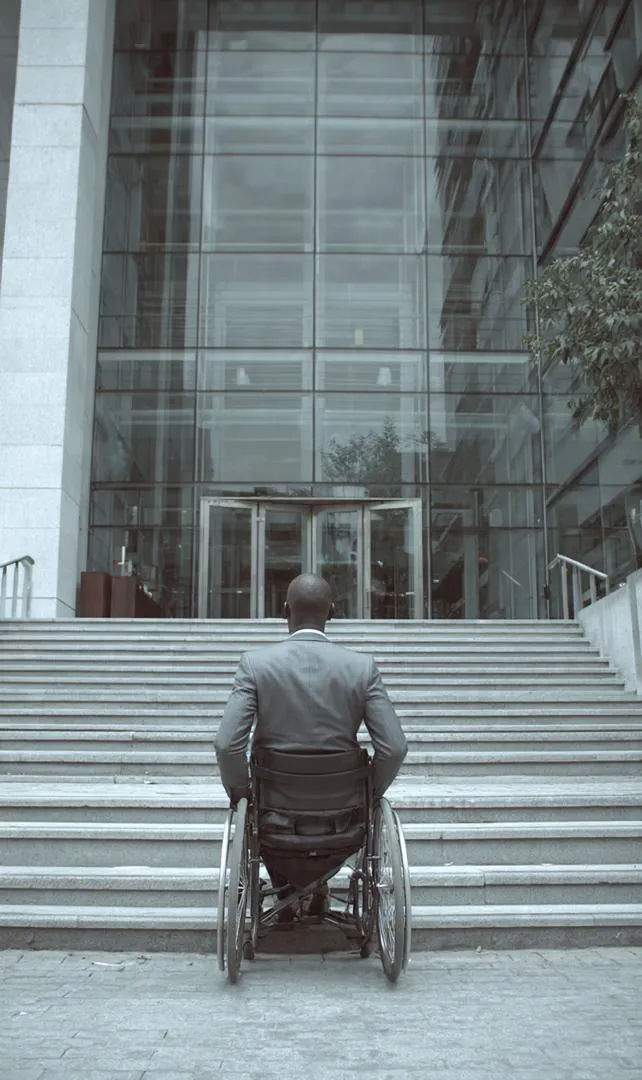
While our peers were deeply supportive of our colleague – regularly volunteering to manually guide him through treacherous, unmapped walkways and steps – the law faculty itself failed to adopt adequate proactive measures. There were no Braille materials, no tactile pathways, and the physical campus remained a minefield of steep stairs, rocky paths, and sudden layout changes.
The university’s law library lacked even a single terminal equipped with assistive technology. Regionally, these protections are mirrored by the African Union Protocol to the African Charter on Human and Peoples’ Rights on the Rights of Persons with Disabilities in Africa (the African Disability Protocol).
This protocol contains uncompromising articles on accessibility and higher education, mandating that African states eliminate all institutional barriers in both physical and digital learning spaces.
This aligns with Article 18(4) of the foundational African Charter on Human and Peoples’ Rights, which grants persons with disabilities the right to special measures of protection in keeping with their physical and social needs.
These protections are further fortified globally by the United Nations Educational, Scientific and Cultural Organization (UNESCO) Convention against Discrimination in Education, which outlaws any form of structural exclusion or limitation of educational opportunities based on inherent personal characteristics.
Domestically and internationally, full structural inclusion is also an unyielding prerequisite for achieving United Nations Sustainable Development Goal 4, particularly Target 4.5, which mandates the total elimination of all disability disparities in education by ensuring equal access to all levels of professional and tertiary training.
Significant Challenges and Gaps in Act 1170
Despite this formidable array of legal safeguards for inclusion, a clinical reading of Act 1170 reveals glaring, highly regressive legislative gaps.
First, there is an absolute statutory silence on the Deaf and hard-of-hearing community. Right now, a Deaf student who qualifies for law school faces an insurmountable linguistic wall because our law faculties do not budget for, nor do they employ, full-time, professional Ghanaian Sign Language (GSL) interpreters in lecture halls, legal clinics, or moot court sessions.
Second, the Act contains highly ambiguous standards regarding digital and library infrastructure. While it superficially mentions “learning accommodations,” it fails to explicitly mandate that university law libraries provide digital databases compatible with screen readers, Braille law journals, or audio legal texts.
The Way Forward: An Enforcement-Driven Blueprint
To move from high-minded academic rhetoric to practical, actionable justice, the state and the Council must immediately deploy a realistic, enforcement-driven blueprint across the new legal education landscape.
- Mandatory Institutional Partnerships
The Council for Legal Education and Training must establish mandatory institutional partnerships. The Council and accredited law faculties must move past institutional ego and establish formal, legally binding working relationships with domestic and international disability advocacy experts, specifically the Ghana Federation of Disability Organisations (GFD) and Sightsavers International Ghana.
These organisations possess the deep, technical expertise required to guide law schools on the exact physical and digital dimensions of accessibility, preventing universities from executing superficial, cosmetic fixes that fail to meet international standards.
- Independent Environmental and Digital Infrastructure Audits
Before any university receives or maintains its accreditation to run an LL.B. or Law Practice Training programme, the Council, with support from accessibility audit experts, must conduct an exhaustive audit of the campus.
Inclusion must start from the architectural design phase of law faculties; for existing older campuses, retrofitting must be an absolute, non-negotiable prerequisite for operation.
These audits must verify the installation of continuous tactile paving, accessible elevators, and continuous ramps with legally compliant gradients for visually and mobility-impaired students.
Furthermore, these audits must ensure the immediate setup of institutional tech hubs within law libraries that provide pre-installed assistive applications, screen-readers, and universally accessible digital legal databases. The audit must ruthlessly cover libraries, lecture halls, restrooms, and administrative offices alike.
- Institutionalising Sign Language Interpretation
Every accredited law faculty must be legally mandated to maintain a dedicated, ring-fenced budget line specifically for professional Ghanaian Sign Language interpreters.
These interpreters must be physically present for all core lectures, legal clinics, and moot court sessions where a hearing-impaired student is enrolled, ensuring that the spoken majesty of the law is fully and equitably communicated to all.
Conclusion
The Legal Education Act, 2026 has successfully broken down the institutional monopoly that held back our legal profession for generations. But as we rebuild this system across multiple universities, let us build it right.
Let us ensure that the next blind, deaf, or physically impaired student who enters any law faculty does not have to rely on the random kindness of classmates or struggle to self-source basic assistive software.
By aggressively closing the legislative gaps in Act 1170 and enforcing strict, audit-driven standards, Ghana can pioneer a legal education system that is truly blind to privilege, but completely embraces equality and justice.
By Samson Addo
The author is a Development Programme Specialist, Financial Inclusion Practitioner, Law Enthusiast, and Disability Rights Advocate. He can be reached at 2010risk@gmail.com.
SOURCE: DisabilityNewsGH.com