Disclaimer: The views expressed in this feature article are those of the author and do not necessarily reflect the official position of DisabilityNewsGH.com.
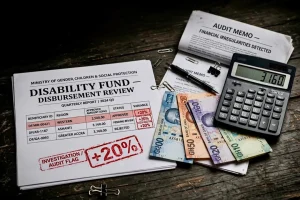
The September 14, 2026 reminder from the Office of the Administrator of the District Assemblies Common Fund is difficult to ignore.
It demands the immediate reconstitution of Disability Fund Management Committees (DFMCs), strict adherence to approval procedures, proper record-keeping and reporting, and greater transparency in the management of the Disability Fund.
More significantly, it warns that Chief Executives, Coordinating Directors and Finance Officers who authorise or process payments in breach of the prescribed requirements may be held personally accountable.
These are not minor administrative matters. They go to the heart of how resources meant for Persons with Disabilities are managed and protected. And yet, the letter raises a question that deserves an equally serious answer: Where is the National Council on Persons with Disability (NCPD)?
The effort being mounted by the Common Fund Administrator to strengthen governance, accountability and transparency in the management of the Disability Common Fund will amount to little if the NCPD itself is not adequately resourced, empowered and properly represented at the various MMDAs.
The Administrator’s own reminder acknowledges that compliance with the prescribed governance arrangements remains inconsistent in some MMDAs.
It therefore becomes even more important to have the institution mandated to coordinate, monitor and advocate for disability interests adequately represented where these decisions are made and implemented.
Yet, for far too long, the secondment of qualified Persons with Disabilities who have expressed their willingness to serve as NCPD representatives at the district level has remained delayed.
If effective monitoring of the Disability Common Fund requires meaningful representation at the local level, why should persons prepared and willing to undertake that responsibility remain in administrative limbo?
And if the explanation is financial clearance, then the question becomes even more pertinent:
Is financial clearance required for secondment in the same manner as it is for new recruitment, or are different administrative procedures applicable? The disability community deserves a convincingly clear answer.
The Public Services Commission identifies financial clearance as a requirement for recruitment into the public service, while the Office of the Head of the Civil Service recognises secondment as a distinct human-resource facility.
If financial clearance is indeed required in this particular case, then the responsible authorities should explain precisely what is causing the delay.
And even where financial clearance is genuinely required, it should not become a convenient explanation for indefinite delay.
We have seen financial clearances processed for Ministries and other public institutions. The question, therefore, is not merely whether clearance is required. It is whether the same urgency and administrative commitment being demonstrated elsewhere are being extended to an institution whose mandate directly concerns one of the country’s most vulnerable groups.
Then comes the second question: Who is protecting the Disability Common Fund?
The September 14 reminder shows that the Common Fund Administrator is actively demanding compliance from MMDAs.
It is calling for DFMCs to be properly constituted, expenditure to receive the required approval, records to be maintained, beneficiaries to be transparently accounted for, and Regional Ministers to use their oversight mechanisms to enforce compliance.
That is significant! But it is increasingly difficult to ignore the emerging impression that the District Common Fund Administrator appears more proactive in addressing the governance challenges surrounding the Disability Common Fund than the very institution whose mandate places it at the centre of disability coordination, monitoring and advocacy.
That should concern everyone who genuinely believes in inclusion.
The issue is not whether the Administrator’s intervention is necessary. It clearly is. The issue is whether the NCPD is being given the institutional capacity, human resources and local representation necessary to perform its own mandate effectively.
Because oversight cannot be effective where the institution expected to provide disability-sector oversight is itself inadequately represented.
And this leads to the third question: Who is accountable? The Administrator’s letter has already made one thing clear: those who authorise or process expenditure in breach of the prescribed requirements may face personal accountability.
Good! But accountability must not end with those who process payments. There must also be accountability for institutional delays that weaken the very structures designed to prevent abuse in the first place.
If resources intended for Persons with Disabilities can be subjected to abuse or misapplication while the structures meant to protect those resources remain inadequately represented at the local level, somebody must answer for that weakness in the system.
This is also where government must demonstrate that its commitment to inclusion, social justice, accountability and transparency extends beyond political rhetoric.
The Disability Common Fund has been increased significantly in 2026. At precisely the moment when more resources are being committed, the mechanisms for monitoring, representation and accountability must become stronger—not weaker.
Persons with disabilities do not need sympathy. They need functioning institutions. They need effective representation. They need transparent systems. They need resources that reach their intended beneficiaries. And they need accountability when those systems fail.
The September 14 directive is therefore welcome for what it demands from the MMDAs.
But it should also provoke a broader national conversation about the capacity of the NCPD to perform its mandate at the local level.
If inclusion matters, then representation cannot remain perpetually delayed.
If accountability matters, then oversight cannot be an afterthought.
And if the Disability Common Fund truly belongs to the people it was created to serve, then the institutions responsible for protecting it must be equipped to do so.
The question is no longer whether inclusion is a cherished principle. The question is whether those who proclaim it are prepared to demonstrate it, in appointments, in representation, in oversight and, ultimately, in the protection and equitable use of resources meant for Persons with Disabilities.
Inclusion must not be proclaimed. It must be demonstrated.
Author: Edward Yennukon Konlan (Disability Advocate__Tel: 0208877853)
Editor’s Note: This feature is published as part of DisabilityNewsGH.com‘s commitment to providing a platform for disability advocates to interrogate issues affecting Persons with Disabilities.
SOURCE: DisabilityNewsGH.com