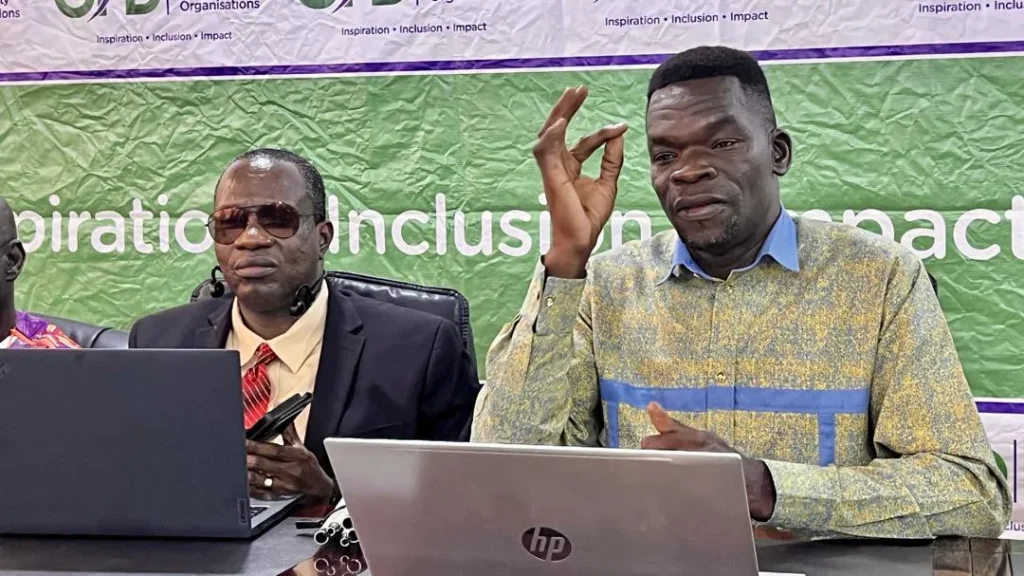
The Ghana Federation of Disability Organisations (GFD) has outlined eight critical recommendations to ensure that the proposed 24 proportional representation seats in Parliament remain inclusive, transparent and free from political elite capture.
The proposal to create 24 special seats for women, youth and persons with disabilities (PWDs) is contained in the ongoing review of the 1992 Constitution.
While welcoming it as a historic opportunity, the Federation wants a specific legislative framework to ensure the seats truly serve the marginalised.
GFD Demands Entrenched Protection Against Future Rollback
Beyond the allocation, the GFD wants the disability quota permanently protected from constitutional amendments, political bargaining and administrative changes.
It insists the seats must be entrenched as a guaranteed minimum, not a discretionary favour that a future Parliament or Executive can erode, suspend or reallocate.
The Federation is calling for explicit anti-rollback clauses to prevent any legislative instrument or directive from reducing the quota or merging it into generic affirmative action categories.
Without such safeguards, it warns, the historic gain could be reversed through elite capture and tokenism, and must therefore be ring-fenced with language that guarantees continuity, enforceability and funding.
8-Point Demand for Inclusive Design
In its detailed 8-point submission, the Federation expands on these protections and outlines additional measures as follows:
1. Explicit Naming in the Constitution: The reform must ensure that persons with disabilities are explicitly named in the constitutional provision, rather than being grouped under vague or generic categories that could render them invisible.
2. Guaranteed Minimums: The allocation to persons with disabilities should be a guaranteed minimum share of the 24 seats. This should not be left as a discretionary number that could be eroded or eliminated through political bargaining.
3. Transparent Electoral Mechanisms: The GFD is calling for an electoral mechanism that gives Organisations of Persons with Disabilities (OPDs) and persons with disabilities themselves a decisive and transparent role in electing their own representatives, rather than allowing political parties to handpick occupants of the seats.
4. Internal Gender Balance: Within the disability quota, there must be deliberate provision for women with disabilities to address the intersecting and compounded barriers of gender and disability.
5. Clear Eligibility Criteria: Legislation must clearly define who qualifies as a “youth” or a “person with disability” representative to prevent abuse of the system. This must be backed by transparent nomination procedures and a credible dispute-resolution mechanism.
6. Full Accessibility of the Process: The entire electoral process, from voter information and education to campaign materials and balloting venues, must be fully accessible, incorporating sign language interpretation, Braille, large print and other forms of reasonable accommodation.
7. Protection from Elite Capture: The Federation is demanding adequate safeguards, including public financing, to ensure that these special seats are not captured by political elites or reduced to token representation.
8. Structured Accountability: Special-seat MPs must be required to have structured, periodic consultations with the disability constituencies they represent, rather than operating independently once elected.
Independent Feasibility Study Must Be Participatory
The GFD further recommended that the independent feasibility study proposed by government to guide implementation must be conducted through a transparent and participatory process.
This process, it said, should include the GFD, regional OPDs, youth and women’s organisations, and the Electoral Commission.
“GFD regards the proposed 24 proportional representation seats as a historic opportunity to make Ghana’s constitutional democracy more inclusive. The reform should not be understood as creating privileged citizens; it is a corrective mechanism that enables those who face persistent structural exclusion to participate on an equitable basis.”
The Federation urged all stakeholders to preserve and strengthen this proposal to ensure it survives in the final constitutional amendment package.
SOURCE: DisabilityNewsGH.com


Very laudable but how are these seats going to be occupied. Will it be through an automatic filling or through the normal contest we normally see during elections