Ghana’s leading organisation driving digital inclusion for vulnerable groups, Inclusive Tech Group (ITG), is calling on corporate Ghana and civil society to partner with it to scale up innovations that advance the independence of persons with disabilities.
According to ITG, it has provided a platform and groomed over 600 young innovators in inclusive technology over the years, with interest growing each year because of its impact.
It however, wants to scale up even bigger and is appealing to more funders and partners to extend its reach.
Technology Innovation Specialist, Dr Ralitsa Diana Debrah, told DisabilityNewsGH.com that ITG remains convinced that digital innovation is central to achieving full independence for persons with disabilities, especially when persons with disabilities co-create the solutions.
She said this year’s event, the 6th edition of the Disability Inclusive Hackathon (DI-HACK), showed remarkable growth in quality and diversity.
This year’s edition brought together seven teams and was held alongside the 10th IEEE International Conference for Adaptive Science and Technology.
The three-day event brings together technology enthusiasts and persons with disabilities, with each team including a person with disability, to co-create viable technological solutions to improve the quality of life of over 3 million Ghanaians with disabilities.
What made this edition different, she noted, was its strong focus on health-related solutions, a departure from the more generalist ideas in previous years, and the promising exploration of Artificial Intelligence by the innovators.
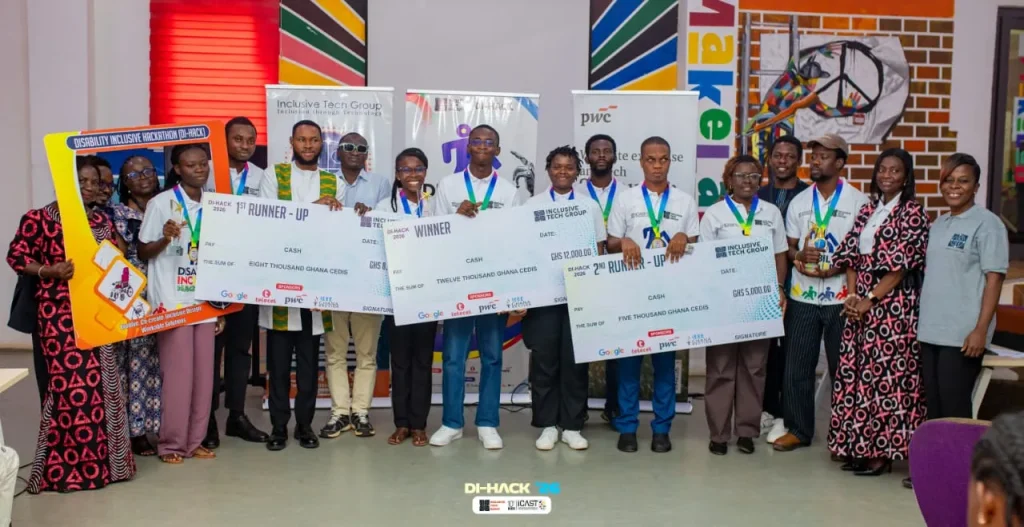
The proof that the model works came from Team Focus, winners of this year’s competition with their innovation, Hands-Free Web Navigation.
Their solution is an assistive browser extension that makes the web accessible to people with severe motor impairments or amputations who may be unable to use a traditional mouse or keyboard.
Using only a standard webcam and computer vision, the extension translates simple head movements, eye blinks and mouth gestures into browser actions – allowing users to tilt their head to scroll, blink to select or use a mouth gesture to click – without the need for specialised hardware.
Judges at the event said the quality showed the products are ready to go beyond prototype.
Mr. Kwaku Ofori Apeadu of PwC Ghana, one of the sponsors who served as a judge, said he saw a lot of potential on display and was impressed that the products addressed different forms of disability, with strong prospects for market viability and job creation.
Dr Joyce Koi-Akrofi of Telecel Ghana, who also served as a judge, believes the hackathon is pushing young people to think outside the box.
She said Telecel was proud to partner with ITG for the third consecutive year because the initiative aligns with its strategic pillar on diversity and inclusion.
To back that vision with practical support, ITG has increased the prize package this year.
According to Dr. Debrah, the prize money for this year’s DI-Hack was increased to help cushion innovators against prevailing economic challenges and enable them to continue developing their prototypes.
Winners received cash prizes, plaques, and medals, alongside an opportunity to benefit from six months of mentorship to support the further development and implementation of their prototypes.
She urged the winners to take the post-hackathon mentorship seriously to turn their ideas into products that truly solve problems.
DI-HACK was born out of a four-year research by ITG’s Executive Director, Dr Millicent Agangiba, on enhancing digital accessibility, which found that involving persons with disabilities in developing assistive technologies yields more accessible and workable solutions.
SOURCE: DisabilityNewsGH.com