Today, as the global community commemorates International Women’s Day, the spotlight falls on a mandate that demands more than just awareness: “Give to Gain: Rights, Justice, Action, For All Women and Girls.”
While many celebrate female leadership in corporate boardrooms and political offices, Janet Augustt is leading a quieter, yet equally profound revolution – one that happens in the silence between words.
As a professional Sign Language Interpreter and a Child of Deaf Adults (CODA), Jane is a living embodiment of this year’s mission.
She is a woman who has converted a childhood of “necessity” into a career of “intentional action,” ensuring that the rights of the Deaf community are no longer sidelined. In giving her life to this cause, she has ensured that thousands gain the dignity and inclusion they deserve.
Linguistic Roots in Kaneshie
In the quiet of a home in Kaneshie-Accra, long before she mastered the phonetics of spoken English, Jane Augustt was already communicating. She didn’t use her voice; she used her hands.
As a Child of Deaf Adults, sign language was not a secondary skill or a classroom elective – it was her mother tongue.
“Sign language was my first language at home,” Jane recalls. “Before I even fully understood spoken language, I was already communicating with my hands.”
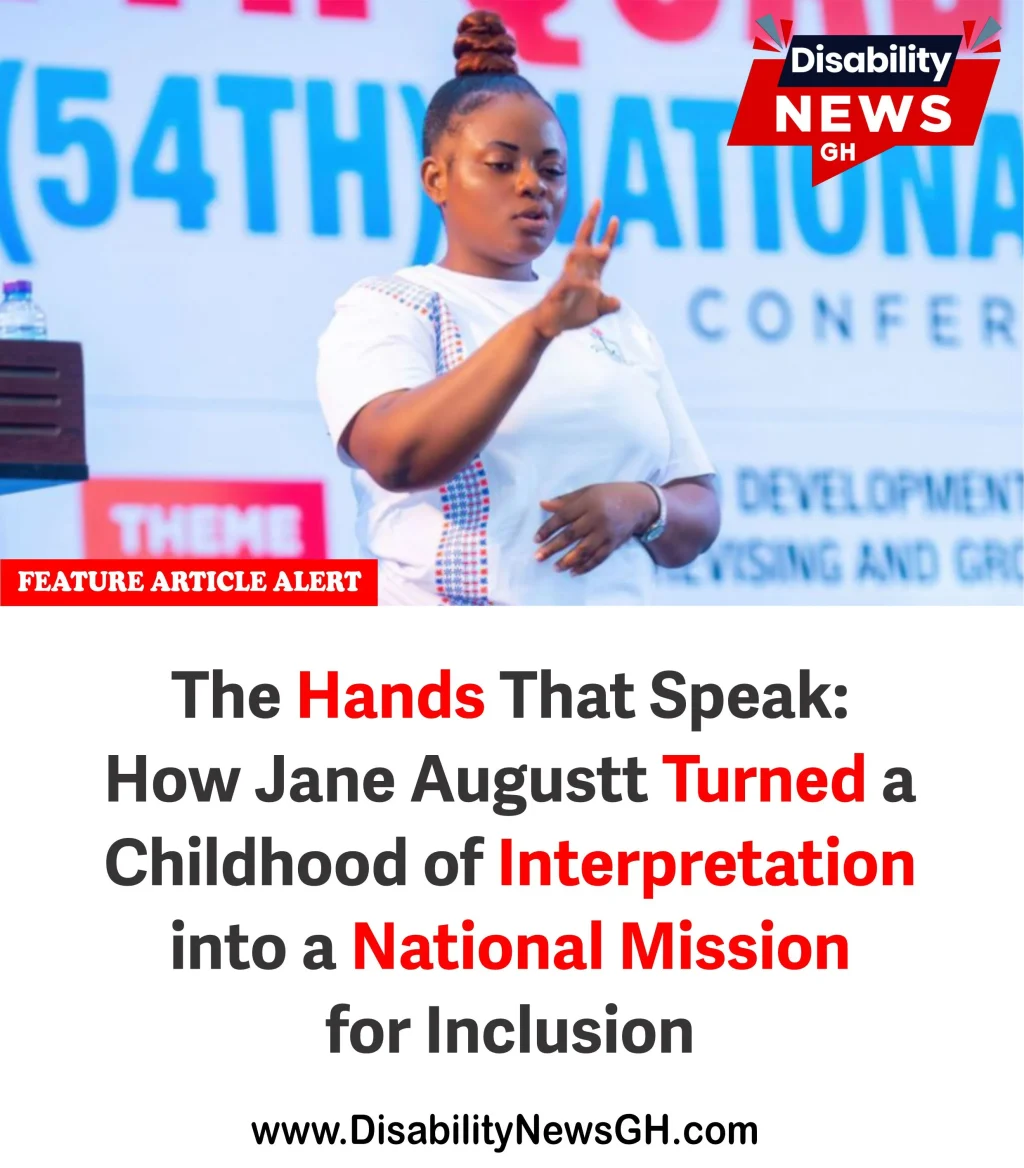
Today, Jane is one of Ghana’s recognisable sign language practitioners, a familiar face on television screens through programmes like Onua Showtime on Onua TV.
But her journey from a young girl navigating social conformity to a professional advocate is a story of intentional growth, shifting perspectives, and a deep-seated drive to bridge the systemic communication gaps in Ghanaian society.
The Weight of a Childhood Bridge
Growing up as a CODA is a unique, often demanding experience that forces a child to mature rapidly. While her peers were playing, Jane was navigating high-stakes environments – hospitals, banks, and administrative offices – acting as the essential linguistic bridge for her parents.
“It made me mature very early,” she says. “That experience shaped my confidence and communication skills from a young age.”
However, that maturity was often tested by the harsh gaze of the public. Like many children of parents with disabilities, Jane initially contended with the stigma attached to deafness.
“As a child, you just want to ‘fit in,’” Jane admits. “But as I grew older, I realised my parents’ deafness is not a weakness; it is a different way of living. I replaced embarrassment with pride.”
Professionalising the Lived Experience
For years, interpreting was simply “life” for Jane. It wasn’t until she observed the broader landscape of Ghana that she realised her lived experience was actually a vital professional tool.
She recognised a massive deficit in communication access that left thousands of Deaf Ghanaians marginalised from essential services and information.
“That’s when it became intentional,” she explains. “I decided to transform a childhood skill into a professional career to serve the deaf community on a national scale.”
Building a career as a woman in this specialised field has not been without hurdles. In Ghana, sign language interpretation is frequently undervalued, and practitioners must constantly battle for professional recognition.
Beyond the external struggles is the “internal toll” of the work. “Interpreting is not just about signing words; it’s about carrying the weight of emotions, tone, and responsibility. It requires immense mental strength,” Jane notes, citing emotional exhaustion as a significant occupational challenge.
Digital Advocacy and the Global Stage
Besides mainstream media, Jane has leveraged the power of social media to become a digital educator, taking her mission beyond the television screen.
By teaching basic signs and advocating for inclusivity online, she is normalising Sign Language for a new generation.
But her vision doesn’t stop at the borders of Ghana. Jane is determined to take Ghanaian Sign Language (GSL) to the international stage.
She advocates for GSL to be viewed not just as a “local help tool,” but as a sophisticated language capable of meeting international standards.
Her goal is to ensure that Ghanaian Deaf individuals can participate in global discourse with the same level of professional support found anywhere else in the world.
Mainstreaming Dignity
Jane’s breakthrough into mainstream media has been a game-changer for disability representation. Her work on Onua TV has brought the Deaf community into the living rooms of millions, proving that inclusive media is both possible and necessary for a functioning democracy.
“Seeing deaf individuals say, ‘For the first time, I understand what is happening on TV,’ is powerful,” she says. “Moments like that remind me that this work is bigger than me. It’s about access and dignity.”
A Legacy of Rights, Justice, and Action
To the children of parents with disabilities (CODAs), and to every young woman seeking her purpose, Jane offers a message born of both grit and grace:
“Be proud of your story. Your upbringing is not a disadvantage – it is a specialised strength. The skills you are building right now – empathy, responsibility, and toughness – are the exact tools needed for leadership. One day, you will realise that your difference was never a burden; it was your greatest gift to the world.”
As Ghana marks International Women’s Day, Jane Augustt stands as a beacon of what happens when personal history is converted into public action.
By giving her voice and her hands to a cause larger than herself, she has ensured that others gain their rights. Today, we celebrate a woman whose hands are doing more than translating words; they are breaking barriers and speaking volumes for the soul of a more inclusive Ghana.
SOURCE: DisabilityNewsGH.com