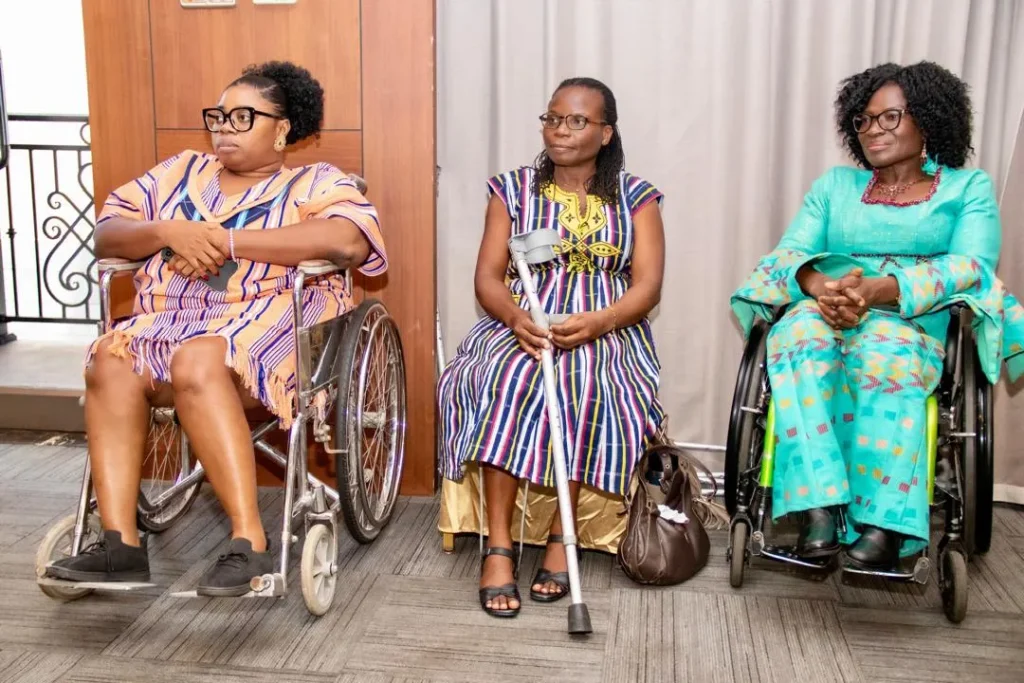
Financial institutions in Ghana are facing renewed scrutiny over widespread discrimination, inaccessible infrastructure, and offensive stereotyping that treat persons with disabilities (PWDs) as charity cases rather than viable bank clients and entrepreneurs.
The indictment was laid bare by Madam Patience Atua, Programmes Manager for Voices of Women and Children with Disabilities in Ghana (VOWACGhana), who recounted distressing experiences of PWDs attempting to access basic banking services across the country.
Highlighting the deep-seated prejudice within the banking sector, Atua revealed how an outdated “charity model” continues to dictate how financial staff perceive clients with disabilities.
Illustrating the daily indignities faced by PWDs, the disability rights advocate shared three poignant accounts of discrimination:
• Assumed to be Beggars: In one instance, a wheelchair user named Joseph entered a banking hall to pay his tertiary school fees. Before he could speak, a bank staff member walked up to him and abruptly stated, “We cannot help you,” assuming he had entered the hall to beg for money.
• Interrogated for Withdrawing Own Money: In Kumasi, Bismark Amoh, a visually impaired man, attempted to withdraw GHC 30,000 from his personal account.
Despite successfully signing his documentation, he was subjected to dodgy, intrusive questioning in the manager’s office simply because staff questioned how a visually impaired individual could legally possess such a sum.
• Denial of Business Credit: A female trader named Gladys has been repeatedly denied business expansion loans despite meeting all standard requirements, while non-disabled peers in the same market effortlessly secure credit facilities to grow their enterprises.
“In Ghana, the charity model of viewing disability remains paramount,” Atua noted. “As a result, persons with disabilities are viewed as incapable and in need of handouts rather than being given opportunities to work, invest, and build businesses. This prejudice transcends all social settings, severely impacting financial inclusion.”
Beyond offensive staff attitudes, Atua highlighted severe physical and digital barriers that render banking halls hostile environments for PWDs.
Physically, many banking halls feature excessively slippery floors, dangerously steep ramps, and Automated Teller Machines (ATMs) mounted at heights completely unreachable for wheelchair users and persons of short stature.
Digitally, most online and mobile banking applications in Ghana lack basic accessibility features, such as compatibility with screen-reader (talkback) software for visually impaired users or text enlargement options for low-vision clients.
The revelations come at a crucial time as Ghana prepares to establish a national Women’s Development Bank.
To ensure that female entrepreneurs with disabilities are not left behind, leadership from VOWACGhana engaged directly with the Technical Committee on the Women’s Development Bank during a high-level meeting at the Jubilee House in Accra.
Atua emphasised that for the Women’s Development Bank to succeed, its operational framework, digital platforms, and credit facilities must be universally accessible from day one.
“Our meeting with the Technical Committee at the Jubilee House was deliberate,” Atua declared. “We look forward to an inclusive financial framework when the bank rolls out, ensuring that ALL women benefit, regardless of disability.”
SOURCE: DisabilityNewsGH.com