Vice President Prof. Jane Naana Opoku-Agyemang has reaffirmed the government’s commitment to strengthening inclusive education, emphasising that a truly united country must make room for everyone, regardless of their physical or neurological differences.
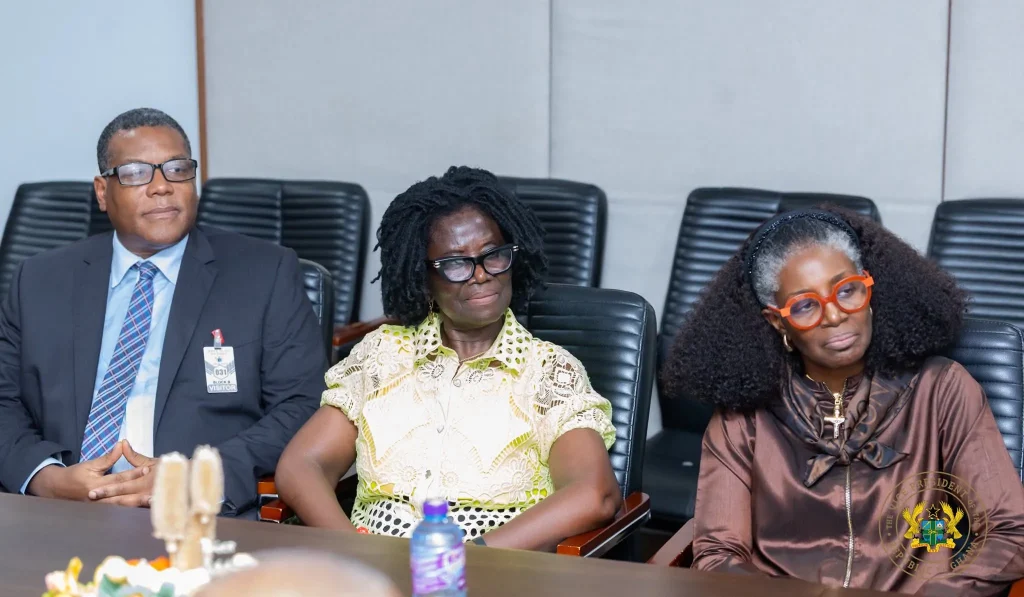
The Vice President made these remarks during a high-level meeting with the leadership of the New Horizon Special School, including board members Ms. Nilla Selormey and Ms. Vicky Wireko-Andoh, as well as the school’s Executive Director, Dr. George Francois.
The visit served to recognise the institution’s long-standing dedication to providing education, vocational training, and employment opportunities to children and adults with special needs.
“We need to acknowledge that everyone is different and that these differences should not be a basis for exclusion,” Prof. Opoku-Agyemang stated.
“It is our duty as a society to remove the obstacles that limit their full participation. One country means making room for everyone, including people with disabilities, whose abilities and contributions manifest in diverse ways”, she added.
The Vice President commended the leadership and staff of New Horizon for their sacrifices and highlighted the critical role of Ghana’s Inclusive Education Policy.
She noted that when society is equipped with empathy and the right tools, it can better support not only children with special needs but also the parents and guardians who care for them.
The Vice President concluded the meeting by reiterating that the government remains committed to working with institutions like New Horizon to ensure that all children in Ghana, regardless of their background, have the opportunity to learn, grow, and thrive.
While the Vice President’s comments were met with appreciation, it also sparked a call for broader systemic reforms from the disability advocacy community.
Hannah Awadzi, a mother and advocate for children with disabilities, in a Facebook post, expressed gratitude for the government’s recognition of specialised schools but warned that many children remain “unseen and unsupported.”
“Many families lack access to services, information, and financial support, leaving children hidden away at home—not by choice, but by necessity,” Awadzi noted.
She specifically highlighted the plight of children with cerebral palsy and other neurological conditions, which she argued are often excluded from mainstream disability interventions.
Advocates are now urging the government to expand its focus beyond classroom walls toward a community-based social protection system.
To ensure true inclusion, Awadzi proposed several critical interventions, including:
• Healthcare Subsidies: Including physiotherapy, occupational therapy, and speech therapy under the National Health Insurance Scheme (NHIS).
• Financial Relief: Introducing caregiver support grants or disability allowances to ease the heavy financial burden on families.
• Community Services: Establishing community-based rehabilitation and respite care, particularly in rural and underserved areas.
• Public Awareness: Launching nationwide campaigns to dismantle the stigma and harmful cultural beliefs surrounding neurological disabilities.
• Mobility Support: Providing inclusive transportation and making assistive devices affordable or free for low-income families.
“Supporting families of children with cerebral palsy and other neurological conditions is not charity,” Awadzi added. “It is a responsibility and an investment in a more just and compassionate Ghana.”
SOURCE: DisabilityNewsGH.com