
The Ministry of Communication, Digital Technology and Innovation has announced ambitious plans for 2026, committing to train 50,000 persons with disabilities (PWDs) across Ghana in coding under the government’s “One Million Coders” programme. This pledge forms part of comprehensive reforms and training initiatives aimed at ensuring the digital inclusion of PWDs and enhancing their effectiveness, efficiency, and quality of life.
The announcement was made by the Minister of Communication, Digital Technology and Innovation , Hon. Samuel Nartey George, during this year’s International Day of Persons with Disabilities (IDPD) celebration on December 3, 2025, held at the NCA Towers in Accra. The event was observed under Ghana’s local theme: “Assistive Technology – Empowering Lives and Advancing Inclusion.”
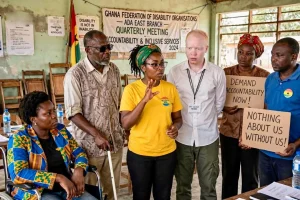
Earlier in the event, renowned Ghanaian Software Engineer with cerebral palsy, Miss Farida Bedwei, delivered a compelling call to action. She urged innovators to involve persons with disabilities directly in their design processes to ensure their needs are duly captured in the designs, emphasising the popular phrase “nothing about us without us.”
Miss Bedwei also spoke passionately about the need to make assistive devices and technological software truly affordable for persons with disabilities, highlighting that these tools are vital for their survival and independence, not merely for luxury.
Minister Nartey George underscored his ministry’s crucial role in fostering an inclusive digital landscape, echoing Bedwei’s sentiments. “On this 2025 International Day for Persons with Disabilities, we affirm a national truth: Ghana grows stronger when every citizen can participate fully in our society,” he stated.
He stressed the importance of co-design, asserting, “Ladies and gentlemen, persons with disabilities must be co-designers of the digital solutions and policies that affect their lives. We encourage those who can to get involved in design and development.”
He emphasised that the local theme serves as a potent reminder that accessible technology is not a privilege but a human right, affirmed by Ghana’s Disability Act (Act 715) and the UN Convention on the Rights of Persons with Disabilities.
He elaborated on the importance of assistive technology, noting, “Assistive technology, whether mobility aids, hearing devices, screen readers, accessible Apps, or communication tools, restore independence, they strengthen productivity and enhance dignity.”
While acknowledging Ghana’s progress in inclusive education, ICT accessibility guidelines, digital public services, and support for local innovation, the Minister also highlighted persistent challenges. “Yet significant gaps persist: affordability challenges, and even access across regions, limited maintenance services, and digital platforms that still fall short of universal design requirements,” he conceded.
In response to these gaps, the Minister made two firm commitments for the coming year. “As a ministry responsible for communication, digital technology and renovation, we recognise our central role in closing these gaps. And so today, I make you two firm commitments,” he declared.
Firstly, the Ministry will strengthen accessibility standards. “We will enforce accessibility across all government digital platforms, ensuring compliance with global standards, such as the World Content Accessibility Guidelines,” Hon. Nartey George promised.
Secondly, the Ministry will advance affordability and accessible communications. He disclosed efforts to be made through the National Communication Authority (NCA) and telecom partners. “Working with the NCA and our telecom partners; Tele MNOs, we will pursue concessionary data options, accessible customer service channels, and encourage industry actors to invest in inclusive technologies,” he said, adding that “Already, the NCA is leading in that regard in meeting with equipment manufacturers to set up a minimum requirement that has accessibility standards for persons with disabilities.”
Minister Nartey George further detailed the government’s flagship “One Million Coders” programme, highlighting its availability to persons with disabilities “to also develop the requisite technical skill to develop software and other technologies.”
He announced that the Ministry is finaliSing the delivery of equipment for a large-scale rollout of the programme, following a successful pilot stage, with full commencement expected across the country in January next year.
During the pilot, the programme trained 859 individuals, but only nine of them were persons with disabilities – “That is not a good enough number,” Minister Nartey George admitted.
To address this disparity, he made a groundbreaking announcement: “In consultation with my colleague minister (for Gender, Children and Social Protection), we have decided to make a public announcement this morning… as we roll out the one million coders programme next year, we will dedicate 50,000 training allocations, fully paid for, to persons with disabilities.”
This ambitious initiative will prioritiSe regional equity, ensuring training is available beyond Accra and Kumasi. The Ministry of Communication will collaborate closely with the Ministry for Gender, Children and Social Protection, working with the Federation to identify recipients across all 16 regions to ensure a critical mass of PWDs undertaking these trainings.
The Minister emphasised the international recognition of these training certificates. “All the training certificates are internationally recognised. So they are trainings for Google, from Microsoft, from CISCO, to allow beneficiaries of the one million coders programme to be able to do remote work. And so, this is a pledge and promise we make and we will fulfil.”
He expressed hope that this enhanced skill set “will be deployed among other things, to develop tools to enhance access for all people.”
Minister Nartey George also extended a call to all stakeholders. “We call on all stakeholders to play their part in expanding access for persons with disabilities,” he urged. “My colleagues and I in Parliament will continue to strengthen disability legislation. We call on the private sector, especially in our telecom sector, to embed universal designs in all products and services. Development partners should also support research and local production of these devices.”
He articulated a powerful vision: “Let us envision Ghana where every learner has accessible digital tools, every citizen can use government platforms without barriers, and local innovators can produce affordable assistive technologies that benefit the nation and beyond.”
Concluding his address, Minister Nartey George reaffirmed, “As we mark this year’s IDPD, may we renew our commitment to building a digital future grounded in dignity, equity, and opportunity for all. Let us ensure technology becomes a bridge, not a barrier in the lives of persons with disabilities.”
SOURCE: DisabilityNewsGH.com




Is good news i will help