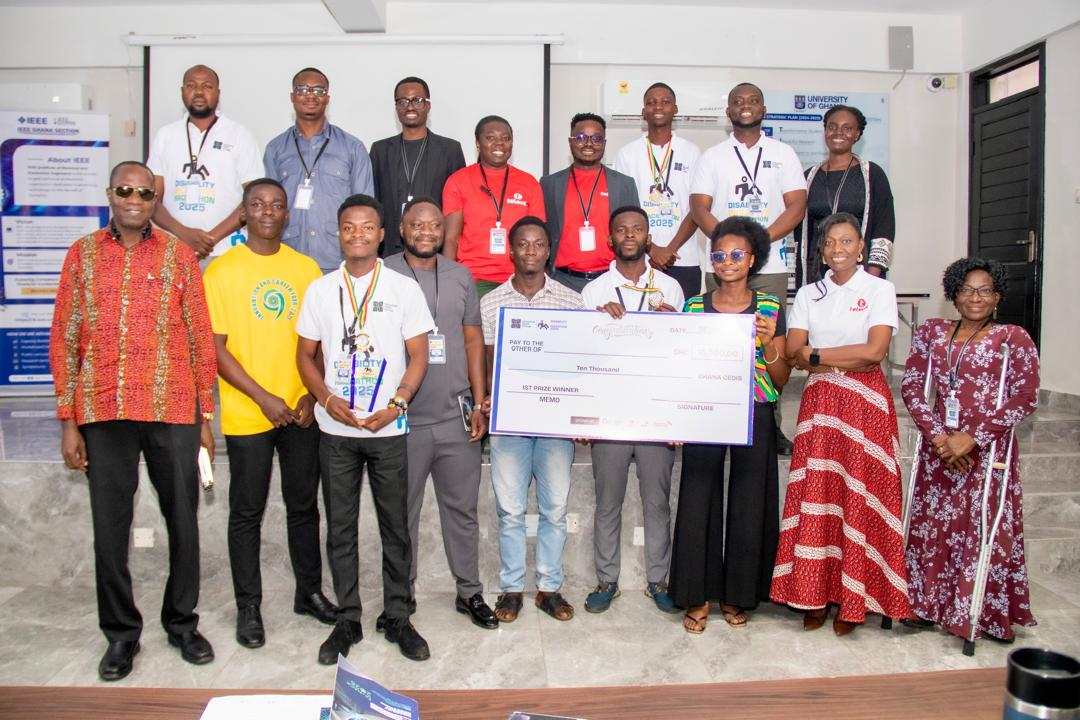
A team of young innovators, Team SMARTi has been crowned champions of this year’s Disability Inclusive Hackathon (DI-HACK), which took place at the University of Ghana from November 26 to 28, 2025.
The event, the 5th edition of the initiative by the Inclusive Tech Group, was held under the theme: “Co-Designing Accessibility – Empowering Persons with Disabilities Through Technology.”
Team SMARTi’s winning innovation is a sophisticated software designed to bridge the communication gap between the deaf and hearing community.
The innovative software translates sign language into text and, in reverse, translates speech into sign language, using a 3D animation for deaf individuals. This first invention is intended for critical institutions such as hospitals, banks, and police stations, with the significant potential to be developed into a widely accessible App for daily interactions between deaf individuals and the general public.
Team SMARTi beat competition from six other teams of young innovators who pitched various solutions aimed at enhancing the lives of persons with disabilities. For their outstanding achievement, Team SMARTi took home a cash prize of Ghc10,000, along with a plaque and medals.
Securing the second prize was Team Fanability Playground and Equipment, whose innovation featured inclusive playground equipment designed to accommodate children with disabilities and their caregivers. They were awarded Ghc7,000, a plaque and medals.
The third position went to Team Octa, who developed a Teraband to help persons with mental health challenges manage their conditions and aid them in daily activities. Team Octa received Ghc4,000, a plaque and medals.
The Disability Inclusive Hackathon is a technology-focused sprint designed to foster digital inclusion by bringing together diverse teams, including individuals with disabilities, to co-create assistive technology solutions. This collaborative approach ensures that products are rooted in lived experiences, addressing real-world challenges in areas like education, well-being, and daily living.
Judges for the hackathon praised the quality and potential of the innovations. Professor Augustina Naami, one of the judges, highlighted the enthusiasm and potential demonstrated by the participants.
“You will agree with me that we have seen an exhibition of great minds and great projects. We have seen how enthusiastic, zealous and how passionate our contestants have been and the energy that they brought. They are very eager to help address the challenges persons with disabilities face”, Professor Naami remarked.
She underscored the global nature of these challenges and the proven role of technology in overcoming them. “What we have witnessed here today really attests to the fact that indeed technology can help address the challenges persons with disabilities experience because a lot is what our contestants showed us here. Innovative products, innovative ideas that definitely have the potential to address issues of persons with disabilities.”
Professor Naami called for greater support, stating, “The government and other stakeholders definitely would have to begin to look into how they can support technologies that address the needs of persons with disabilities. If we don’t want to leave persons with disabilities behind then we need to begin to think about inclusive technology.”
Fellow judge Mr. Alexander Bankole Williams echoed this sentiment, emphasising the critical need for such solutions. “It’s been a great experience,” Mr. Williams commented. “What we have needed and continue to need are innovations that further bring to bear the functioning capacity of persons with disability, and I think we have seen some today.”
He added that the event offered significant hope. “For what we have seen, I think that, with the availability of good funds, even for all seven teams, there is a need to invest in what they proposed. Invest in both funds and technical capacity, to enable them flesh the ideas out better and be able to implement them well for better. For these are all ideas that will end up benefiting persons with disabilities, aiding them manifest their functional capacity better and therefore, enabling them participate in the society on a more equal basis with their peers or counterparts without disability.”
Mr. Joseph Aboagye, Project Coordinator at Inclusive Tech Group, lauded the event’s success. “It has been a great event so far from the first day to the very end. We’ve witnessed great minds working together to co-create assistive technologies for persons with disabilities, and all persons with disabilities here could see how inclusive this DI-HACK has been,” he told DisabilityNewsGH.com.
Mr. Aboagye expressed particular admiration for this year’s innovations. “We’ve seen greater innovations and our judges were impressed because how this assistive technologies are going to help persons with disabilities is just marvelous. We are hoping to shape the projects that have been selected so far to make sure that they are in the very best position and useful for persons with disabilities within Ghana and beyond.”
He highlighted a distinct shift in the nature of the solutions presented. “This year’s innovation is very different from the previous ones that we witnessed. This year, we could see that the technocrats were targeting more software-based assistive technologies, and some of them were targeting lesser-known disabilities.”
Crucially, the event also secured vital post-hackathon support. Mr. Aboagye noted that “today’s event we brought onboard a lot of sponsors who are interested in helping people co-create assistive technologies and these sponsors have spoken with the teams and have assured them that even after the DI-HACK, the post-hackathon mentorship will be offered to them for free.”
He affirmed, “All winning teams are going to have the mentorship from these people for free, and we are making sure that they are going to have the best products that they are going to create for persons with disabilities.”
Further solidifying this commitment, the three finalist teams will specifically enter a post-hackathon mentorship programme with Aaenics Engineering Limited. Kweku Effah, founder of Aaenics, a tech and robotics company specialising in micro-manufacturing and running a maker space, explained their role.
“We come in where the student or the participants have been able to come up with their ideas but then they want to push it into the market,” Mr. Effah stated. “So, we come in to give them the space where they can be able to iterate their prototypes furthermore so that it can be market-ready or to become marketable products.”
He expressed admiration for the teams’ dedication: “The energies they put in was exceptional, and I think they should just keep on with that same energy even throughout this post-hackathon we are going to be doing. If they keep that particular energy, I’m sure we are going to have very scalable project coming out of this DI-HACK programme.”
This year’s event was sponsored by Telecel Ghana, IEEE Instrumentation and Measurement Society, PwC Ghana, and Google.
The 2025 Disability Inclusive Hackathon has once again demonstrated the power of co-creation and technology in driving solutions for disability inclusion, fostering a future where accessibility and empowerment are at the forefront of innovation.
SOURCE: DisabilityNewsGH.com