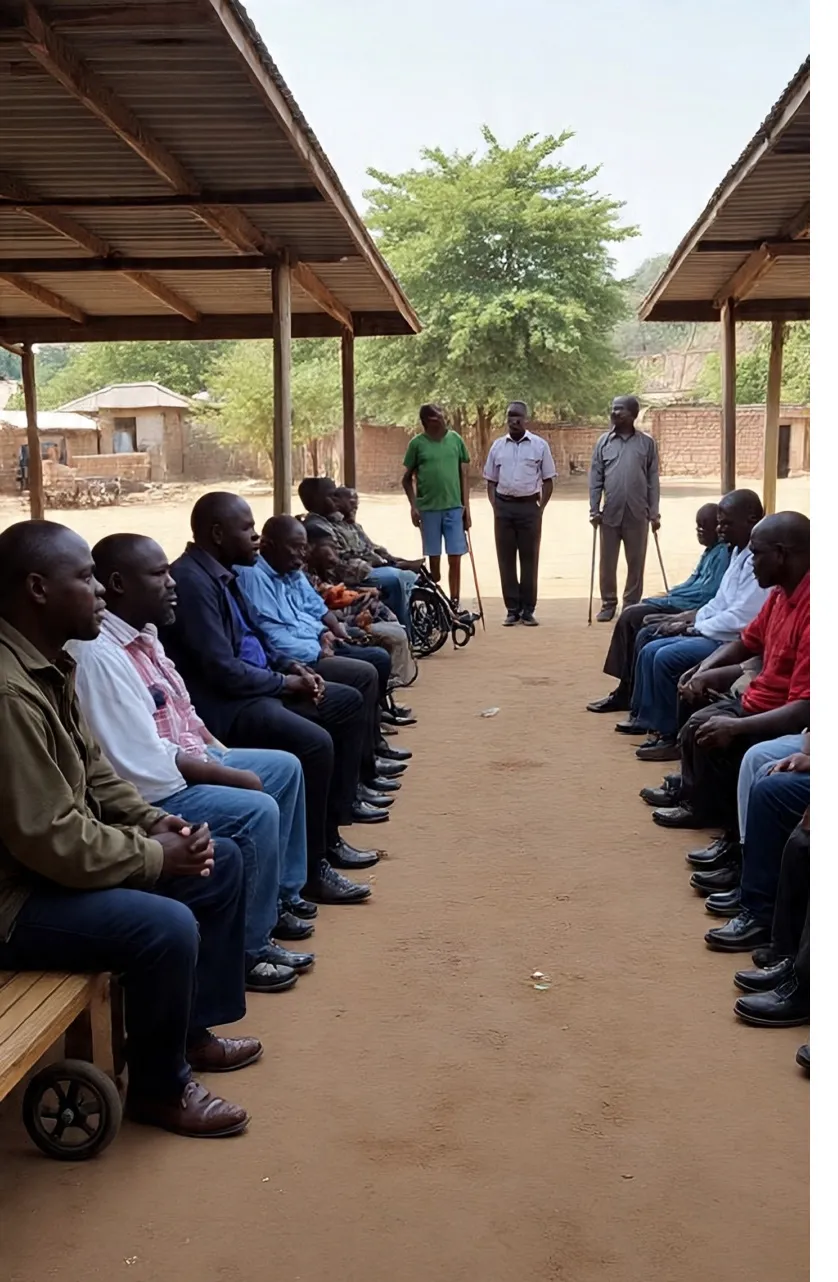
In our recent research into disability inclusion in the Adenta Municipality, we sought to answer a fundamental question: Is there truly a chair at the table for everyone?
When we talk about ‘community development’ in Ghana, we often picture communal labour or town hall meetings at the Chief’s palace.
These are the engines of local progress. However, as researchers, we found that we must look closer at the circle: Are our brothers and sisters living with disabilities truly part of the movement, or are they merely watching from the sidelines?
In the Ghanaian setting, participation is often measured by physical presence, that is, who
showed up to dig the trenches and who did not. But true participation for Persons with Disabilities (PWDs) aren’t just about being “included” in a headshot for a project report. It demands urgency, accessibility, functional systems, and equality.
Community development is widely promoted as a way to improve people’s lives through
coordinated efforts that address local needs.
In practice, however, development only becomes meaningful when affected people, especially marginalised groups, can participate in vital stages such as planning, implementing, and evaluating projects.
In Ghana, one major concern is whether Persons with Disabilities (PWDs) are genuinely included in community development services, or whether they are treated as passive recipients of decisions made elsewhere.
A study conducted in the Adenta Municipality of Ghana explored the views of PWDs on their
participation in community development services.
The mixed-methods approach was used; the researchers worked with 50 PWDs through researcher-administered surveys and focus group discussions.
Quantitative data were analysed using frequencies and percentages, while qualitative responses were examined through content analysis.
Their findings depicted a mixed picture of development outcomes for PWDs in the Municipality.
Respondents generally rated some services, such as education and health, as relatively
satisfactory.
Educational and health initiatives, according to the participants, have improved in some ways over time. For example, focus group participants highlighted that there are now more inclusive schools and programmes for PWDs. This suggests progress toward broader access to opportunities.
Nevertheless, the study also revealed major gaps. Most respondents reported that economic
development and employment creation initiatives were not satisfactory.
More importantly, PWDs felt that development initiatives to support alternative livelihoods were limited and that measures to sustain community projects were inadequate.
Even where projects exist, they were often not designed with accessibility in mind. Respondents stated that many development projects were not PWD-friendly, meaning they did not adequately consider the physical,
communication, and support needs of PWDs.
A central issue was participation itself. The study found that PWDs’ involvement in community
development was generally low across multiple stages.
Many respondents indicated limited participation in assessing community development needs, identifying problems, defining goals, and identifying solutions.
Their engagement in designing development activities and mobilising resources was also weak. In addition, their findings suggested that PWDs were not engaged before project delivery, whether NGOs, communities, or state-led projects.
Participants described a sense of exclusion, where they were not treated as equal partners in deciding what development should look like.
The overall study argues that one-way communication and weak inclusion practices hinder
PWDs from assisting in shaping development services that affect their lives.
To address these challenges, the researchers recommended that development actors adopt inclusive and
participatory communication strategies, use multiple accessible channels, identify and engage
disability groups, and involve PWDs at all stages, including monitoring and evaluation.
PWDs should be treated not as beneficiaries alone, but as active partners whose experiences and
knowledge can strengthen development outcomes.
In a nutshell, development is a symphony. In Ghana, we have many beautiful instruments, but
the music is only complete when every hand, no matter its strength or form, is allowed to play its
part.
The focus must shift from questioning participation to ensuring that the over two million persons with disabilities (PWDs) in our population are enabled to play critical roles in decision-making processes.
About the authors
Jochebed Thompson is an MPhil Student in Administration in Higher Education.
(jochebedthompson@gmail.com)
Lawson Kwame Lugu holds an MA in Development Communication
(lawsonkwamelugu@yahoo.com
SOURCE: DisabilityNewsGH.com