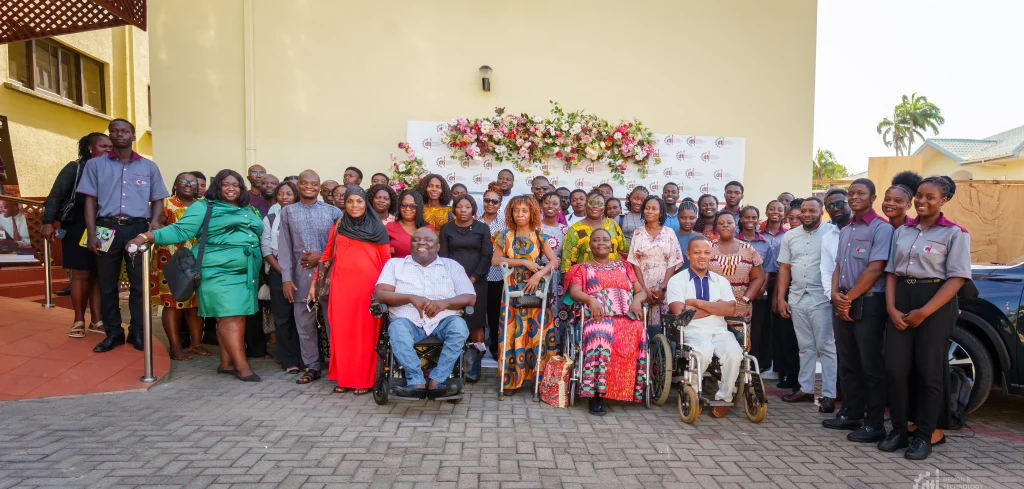
Stakeholders at a high-level gender, safeguarding, and inclusion workshop have issued a strong call for Ghana to move beyond symbolic commitments toward genuine, system-wide inclusion for persons with disabilities (PWDs).
Participants challenged what they described as a culture of “pretend inclusion”- where policies exist, but implementation remains weak, fragmented, and often reduced to compliance-driven box-ticking rather than meaningful transformation.
The workshop, held in Accra on March 26, 2026, marked a decisive shift from awareness to action, calling for a fundamental redesign of institutional systems that continue to exclude persons with disabilities and other vulnerable groups.
Organised by the Design and Technology Institute (DTI) with support from the Mastercard Foundation, the convening brought together policymakers, practitioners, and ecosystem leaders to confront structural gaps in Ghana’s inclusion agenda.
Delivering a candid assessment, Professor Joana Salifu-Yendork, Director of the Centre for Disability Studies and Advocacy at University of Ghana, urged institutions to abandon performative approaches to inclusion.
She highlighted persistent systemic biases, including practices where organisations prioritise individuals with less visible or “manageable” disabilities to meet diversity targets – an approach she described as fundamentally exclusionary.
“Too often, inclusion is reduced to ticking a box,” she noted, calling for a deliberate break from entrenched cultural and colonial legacies that continue to shape perceptions and limit opportunities for persons with disabilities (PWDs).
Ms. Constance Swaniker, Founder and President of the Design and Technology Institute (DTI), framed the moment as a critical inflection point.
She emphasised that exclusion is not incidental, but embedded within institutional design.
“Inclusion is not a programme; it is a property of the system,” she stated.
Drawing on DTI’s experience, she shared how supporting a learner with hearing impairment required a complete redesign of instructional delivery – through sign language interpretation, adaptive pedagogy, and specialised equipment.
“Inclusion is not charity. It is not compliance. It is good design – and a strategic imperative for any institution preparing a workforce for a rapidly evolving economy,” she added.
Bringing a policy and governance perspective, Emma Lillian Bruce-Lyle, a retired civil servant and disability advocate, called for a whole-of-government approach to disability inclusion.
She proposed that all Ministries and State-Owned Enterprises (SOEs) be mandated to allocate dedicated budget lines for disability inclusion, rather than centralising responsibility within a single ministry.
“Without financial commitment, inclusion will remain aspirational. Budgeting is what translates policy into action,” she stressed.
The workshop, themed “Beyond Awareness: Implementing Global Best Practices,” examined critical issues including policy frameworks, education within Ghana’s TVET system, data gaps, and systemic barriers affecting persons with disabilities and refugee women.
A central conclusion emerging from the discussions was that Ghana’s challenge is not policy absence, but a capacity deficit – the lack of technical expertise, operational systems, and accountability mechanisms required to translate intent into impact.
Ms. Swaniker underscored that institutional willingness alone is insufficient without the systems and capabilities to operationalise inclusion at scale.
The convening brought together representatives from the National Development Planning Commission, UN agencies, academia, industry, civil society, and disability organisations.
It concluded with the development of a clear, action-oriented roadmap, committing participating institutions to embed safeguarding and inclusion into core systems, practices, and performance frameworks – moving Ghana closer to making inclusion a lived reality rather than a stated ambition.
About the Design and Technology Institute (DTI)
The Design and Technology Institute (DTI) is a private technical and vocational education and training (TVET) centre of excellence based in Accra, Ghana.
Focused on bridging the gap between industry and academia, DTI delivers world-class training in precision engineering, welding, and advanced technical skills.
Through its partnership with the Mastercard Foundation’s Young Africa Works initiative, DTI is driving the Precision Quality (PQ) movement – embedding global standards, productivity, safety, and professionalism across Ghana’s skills ecosystem.
DTI’s mission is to transform the technical workforce by equipping young people – particularly women and persons with disabilities (PWDs) – with the skills, mindset, and opportunities required to power Ghana’s industrial and economic transformation.
By integrating safeguarding and inclusion into its institutional DNA, DTI is positioning itself as a model for inclusive, industry-led TVET systems across Africa.
SOURCE: DisabilityNewsGH.com