Disclaimer: The views expressed in this feature article are those of the author and do not necessarily reflect the official position of DisabilityNewsGH.com.
I do not write about the Disability Common Fund as a detached observer. I write as someone who has personally benefited from it and who understands, through direct experience, the difference that timely and fairly administered support can make to a person with a disability.
That difference is why accountability must go beyond the usual evidence of disbursement: photographs of dignitaries at ceremonies, the headcount of beneficiaries, and the items displayed for distribution. Those may tell part of the story, but they do not answer the questions that matter to the people the Fund exists to serve. Was the allocation released in full? Were decisions made fairly? Did the intended beneficiaries receive the support? Were the resources properly accounted for? And when something goes wrong, who is answerable?
The Fund is not a favour bestowed on persons with disabilities. It is a public resource intended to address the barriers that have kept many Ghanaians with disabilities from participating fully in social, economic and public life. Its purpose is therefore larger than the disbursement of money. It concerns dignity, access, participation and the practical meaning of inclusion for the more than 8 per cent of Ghanaians whom the Ghana Statistical Service (2021) reports as living with a disability. When the Fund is delayed, misapplied, poorly documented or inadequately monitored, the consequences are not just administrative. They fall on people whose education, livelihoods, assistive devices and other support depend on it.
A letter that leaves one question unanswered
On 14 September 2026, the Office of the Administrator of the District Assemblies Common Fund (DACF) issued a letter, RE: Reminder – Strengthening the Governance, Accountability, and Transparency of the Disability Fund: Compliance Required (Ref. DACF/ADMIN/PWDs/26), signed by the Administrator, Mr Michael Harry Yamson. It demands the reconstitution of Disability Fund Management Committees, strict adherence to approval procedures, and proper record-keeping and reporting. It concedes that compliance remains inconsistent in most Assemblies. It warns that Chief Executives, Coordinating Directors and Finance Officers who authorise or process payments in breach of the requirements may be held personally accountable. And it leans on the oversight of Regional Ministers (Office of the Administrator of the DACF, 2026).
These are important administrative safeguards, but they leave one institutional question unanswered. Where does the National Council on Persons with Disabilities (NCPD), the statutory institution clothed with an accountability role in the Fund, fit into the arrangements the Administrator has issued?
The question is not whether District Assemblies should be accountable. They must be. Nor is it whether Regional Ministers should exercise oversight. They should. I would be surprised if the Administrator were unaware that the NCPD is grossly unrepresented at district level, contrary to what the Guidelines require. So why not use this opportunity to work with the Council and strengthen the very accountability the letter seeks? That institutional gap deserves the same attention as the conduct of the officials who administer the money.
NCPD’s role prescribed, not optional
The NCPD was established by the Persons with Disability Act, 2006 (Act 715), and the 2024 Revised Guidelines for the Management and Disbursement of the DACF for Persons with Disabilities assigned its district representative clearly defined responsibilities. That officer supports disability sensitisation; monitors, supervises and evaluates use of the Fund; maintains registers of persons with disabilities, their organisations and beneficiaries; receives complaints; circulates information on allocations; and reports periodically to the NCPD Executive Secretary (DACF, 2024, secs. 1.5, 3.2 and 6.2). The same officer sits on the Disability Fund Management Committee as a member and its secretary (DACF, 2024, secs. 2.2 and 2.4), and is a signatory to the Fund account alongside the Coordinating Director and the Finance Officer (DACF, 2024, sec. 7.1).
Taken together, these provisions make the representative the Fund’s record-keeper, its complaints desk and one of its three signatories. Where no representative exists, who keeps the register, who hears the complaint, and who signs?
Ghana’s international commitments point the same way. Article 33 of the UN Convention on the Rights of Persons with Disabilities, which Ghana ratified in 2012, requires states to designate focal points within government and to maintain a framework to promote, protect and monitor implementation, with persons with disabilities participating fully in that monitoring (United Nations, 2006).
Nine districts out of 261, twenty years on
I am informed reliably, by the NCPD itself, that nine NCPD representatives are on secondment in nine districts. That is nine of 261 Metropolitan, Municipal and District Assemblies: about 3.4 per cent coverage, twenty years after Parliament passed Act 715 (Persons with Disability Act, 2006). No reasonable reading of “twenty years” can make this a start-up problem. It is a failure of will, and it has outlasted governments of both major parties.
The nine secondments prove that district deployment is possible. But a secondment is a temporary loan, not a permanent post, and after two decades the Council should long since have had permanent district positions.
In March 2025, persons with disabilities who are already on the public payroll applied to serve the NCPD at district level. As one of those applicants, I can confirm that nineteen months later there has been no written feedback of any kind. Not an acknowledgement, not a rejection, not a timetable. If the explanation is financial clearance, then the question is plain. Financial clearance is the Ministry of Finance’s permission to recruit new staff. Why should it block the secondment of officers who are already on the payroll and willing to serve? And if some form of clearance really is required, why has clearance been found for other institutions and not for the body charged with protecting one of the country’s most vulnerable groups? The NCPD owes the applicants and the disability community a written answer: how many applications it received, how they are assessed, what is holding them up, and when more districts can expect an officer.
What absence looks like in practice
Though the subject is emotionally charged, I have chosen to remain restrained here. The cases below are offered as evidence of how irregularities surface, not as verdicts on individuals, and nobody can say that an NCPD officer’s presence would have certainly prevented any of them. But when public money meant for persons with disabilities cannot be shown, cannot be released or cannot be explained, the public and, for that matter, PWDs have every right to ask who in the district was charged with watching it. Each case below shows the absence of exactly what the Guidelines assign to the NCPD representative: the record-keeping role, the complaint-receiving role and the duty to escalate unresolved concerns.
On 10 June 2026, during a monitoring tour of Assemblies in Greater Accra, the Local Government Minister, Ahmed Ibrahim, found that Ayawaso Central Municipal Assembly could not immediately account for more than GH¢400,000 allocated for persons with disabilities. Preliminary records showed that only about GH¢126,000 had been spent, and he directed the Assembly to produce its records. The Municipal Chief Executive says the balance sits in a dedicated account pending vetting of eligible beneficiaries (MyJoyOnline, 2026). Take that explanation at face value. A vetting process that holds back most of a year’s allocation is a beneficiary-register problem, and maintaining the register is one of the NCPD representative’s prescribed duties.
The Daffiama-Bussie-Issa District offers a different kind of evidence, because it rests on an admission, not an allegation. Appearing before Parliament’s Select Committee on Local Government and Rural Development, the District Coordinating Director acknowledged on camera that the Assembly had withdrawn money meant for persons with disabilities in breach of the Guidelines, and evidence of a refund could not immediately be produced to the committee’s satisfaction. The footage is widely available on social media. It is painful to watch, not because of what a critic alleges, but because of what the accountable officer concedes. The Guidelines make the NCPD representative one of three signatories to the Fund account (DACF, 2024, sec. 7.1), so a withdrawal in breach of them is, at the least, a failure of the account-control safeguard that the NCPD seat exists to provide. No NCPD officer is posted to this district. That makes one question unavoidable: whose signature stood in for the representative’s when the money was withdrawn?
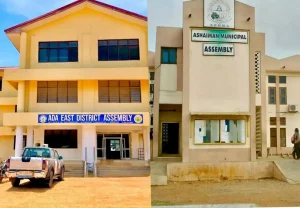
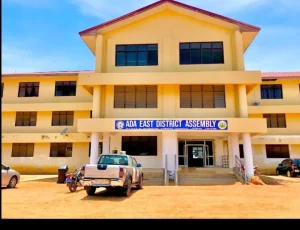
Ada East shows the same weakness from another angle. In December 2025, persons with disabilities boycotted a planned disbursement, citing alleged procurement breaches (Puplampu, 2025). An inquiry by the Assembly itself followed, prompted by concerns that items had been purchased for beneficiaries instead of the cash the Fund Management Committee had reportedly approved. In August 2026, the General Assembly rejected the ad hoc committee’s preliminary report as insufficiently evidenced. That report had rested mainly on the testimony of the Fund Management Committee’s chairman, its secretary (the Director of Social Welfare), and a supplier interviewed by telephone (Puplampu, 2026). The 2024 Guidelines reserve the secretary’s seat for the NCPD representative (DACF, 2024, sec. 2.4). The Assembly was, in effect, examining its Fund through the evidence of the officials who ran it. The investigative report that followed reportedly detected a plot to conceal the irregularities, and the Director of Social Welfare was asked to resign. The sequence is instructive: it took a boycott by the beneficiaries, two inquiries and a rejected report to reach consequences, and nothing in the public record suggests that a standing district monitor raised the matter earlier.
Notice how each of these cases came to light. Ayawaso Central surfaced during a Minister’s monitoring tour, Daffiama-Bussie-Issa under questioning by a parliamentary committee, Ada East after beneficiaries walked out of a disbursement, and Ejura only when persons with disabilities themselves petitioned CHRAJ. In none of them does the public record show detection by the standing, district-level monitoring function the Guidelines created, and that is precisely the function that is missing. A system that depends on ministerial tours, parliamentary hearings and the patience of persons with disabilities is not an accountability system. It is a lottery.
Nor are these isolated. At a capacity-building seminar in the Eastern Region, the Chairperson of Parliament’s Select Committee on Local Government, Queenstar Maame Pokua Sawyerr, said many Assemblies had received their PWD allocations and yet failed to disburse them, and that she did not know why. The committee also cited discrepancies in DACF accounts and warned that officials found culpable would face sanctions (Ghanaian Times, 2026; Graphic Online, 2026). The national leadership of the Ghana Federation of Disability Organisations has said that almost all of its 261 district-level bodies complain of a lack of transparency in how the Fund is disbursed (Graphic Online, n.d.). That is not a few bad Assemblies. It is a system with no dependable eyes at the district level.
As indicated above, my own municipality is another notorious example that cannot be ignored in this narrative. In Ejura-Sekyedumase, persons with disabilities, myself included, have pursued information on the 2022 allocation, the 3 per cent share of the Municipal Assembly’s Common Fund meant for persons with disabilities, which was not disbursed to its intended beneficiaries. After earlier attempts at local engagement failed, we lodged a complaint with the Commission on Human Rights and Administrative Justice (CHRAJ) in October 2025. The Ashanti Regional CHRAJ office invited the Assembly to respond. During the engagement, the Assembly asked that the complaint be withdrawn for administrative resolution, on the strength of assurances that concrete steps would follow. We chose dialogue over confrontation and agreed.
The Municipal Chief Executive and the Director of Social Welfare and Community Development acknowledged the misapplication of the fund and pledged to refund the amount. More than eight months after 16 January 2026, that pledge has not been honoured. Public money meant for persons with disabilities has been acknowledged as misapplied, promised back, and left unreturned. That is impunity, and the public knows it.
In fairness, the current Municipal Chief Executive inherited this matter, and persons with disabilities cannot fairly blame him for decisions made before his time. But a change of office neither erases the obligation nor absolves the Assembly of having misapplied the funds.
To the best of my knowledge, persons with disabilities in this municipality have no local NCPD officer whose job was to notice the anomaly and receive their complaint when it came to light. We had to travel the long road to a regional human rights office to file a petition. A representative could not have guaranteed a different outcome, but the complaint would have had a home, a record and a route upward long before it became a petition.
Regional oversight is not a substitute
Regional Ministers can ensure that Assemblies follow procedure and can escalate what districts will not resolve. That is valuable. But a Minister is a political and administrative overseer, whereas the NCPD has a disability-sector mandate and specific functions under the Guidelines. One cannot stand in for the other.
The Administrator’s letter does not say that NCPD functions have passed to Regional Ministers, and I do not suggest it does. My point is simpler. The letter does not say who performs those functions, whether the representative is present or absent. If an Assembly fails to keep beneficiary records, or a complaint goes unanswered, the public should be able to name the institution responsible for noticing, the official obliged to report, and the place where unresolved concerns go.
Disability Desks and NCPD representation: the same, complementary, or a substitute?
The NDC’s 2024 manifesto, Resetting Ghana, promised to increase the disability share of the Common Fund, establish district-level Disability Funds, strengthen and resource the NCPD, and create Disability Desks in all Assemblies (National Democratic Congress, 2024, p. 120). On 24 October 2025, at the launch of the Free Tertiary Education policy, President Mahama announced that Disability Desks would be created in all MMDAs and would, in consultation with local branches of the Ghana Federation of the Disabled, prepare an annual budget for the five per cent allocation (Yire, 2025).
These promises matter, but the two institutions must not be confused. A Disability Desk, sitting inside the Assembly, would deliver services and coordinate. The NCPD representative is a national monitor with independent reporting lines. If the same person is both, the watchdog is on the payroll of the body it watches, and one must ask how effective that could be. The better design is both: a Desk coordinator to do the work, and an NCPD representative to check that it was done. The distinction between the two posts needs to be spelled out and the Guidelines updated, so that one does not quietly swallow the other.
More money, the same thin chain
The 2026 Budget Statement raises the disability allocation in the Common Fund from three to five per cent (para. 437), commits part of it to rechargeable motorised wheelchairs (para. 438), and states that distribution will go through the NCPD (para. 439) (Ministry of Finance, 2025). The disability community received that news well. Ten months on, however, only the increase and free tertiary education have been implemented.
That makes the question of the NCPD’s capacity urgent, because the Council has been handed a national distribution task while holding formal representation in just nine districts. How will beneficiaries be identified in the other 252? Who will confirm that a wheelchair reached the person it was meant for? A larger allocation demands accurate registers, transparent decisions, accessible complaint channels and timely reports. Without them, the increase risks inheriting the very weaknesses that have drawn scrutiny. Persons with disabilities do not need sympathy. They need functioning institutions.
What must happen now
The NCPD should publish the facts: the applications received, their status, the deployment criteria, the constraints, and the interim arrangements it will put in place if the Administrator’s letter is to be given practical effect.
The Administrator’s Office should be seen to work closely with the NCPD. It should clarify how the Council’s functions fit with Fund Management Committees, Assemblies and Regional Ministers, including who signs to validate information in the representative’s absence, and how information on fund releases reaches regional authorities and NCPD representatives, with clear timelines for disbursement and feedback.
The Ministry of Gender, Children and Social Protection and the Government should ensure that permanent NCPD representatives are appointed across all 261 districts, and should say in clear terms how Disability Desks and NCPD representation will relate.
Persons with disabilities and their organisations must be genuine participants, from learning of releases through procurement, distribution and monitoring. Being invited to a meeting is not consultation. Consultation means receiving information, raising concerns and getting answers.
Inclusion must be demonstrated, not proclaimed
Equality does not arrive by declaration. It needs resources, rules, and people whose names and offices we can point to. So I return to my first question. Now that NCPD representation is absent in most districts, who does the work assigned to it? Who hears the complaint, spots the gap and follows it through? These are not attacks on any institution. They are what any working accountability system should be able to answer.
If inclusion matters, the institutions charged with delivering it must be present, resourced and answerable. And where they are absent, the public deserves to know why.
Edward Yennukon Konlan
Civic and disability-rights advocate, Ejura-Sekyedumase; MPhil candidate, Disability, Rehabilitation and Development Studies, KNUST.
References
- Constitution of the Republic of Ghana. (1992).
- District Assemblies Common Fund. (2024). Revised Guidelines for the Management and Disbursement of the District Assemblies Common Fund for Persons with Disabilities. Office of the Administrator of the District Assemblies Common Fund.
- Ghana Statistical Service. (2021). 2021 Population and Housing Census [Disability report].
- Ghanaian Times. (2026). Parliamentary committee questions delay in release of PWD funds. https://ghanaiantimes.com.gh/parliamentary-committee-questions-delay-in-release-of-pwd-funds/
- Graphic Online. (n.d.). GFD calls for transparency with PWDs common fund disbursement. https://www.graphic.com.gh/news/general-news/ghana-news-gfd-calls-for-transparency-with-pwds-common-fund-disbursement.html
- Graphic Online. (2026). Don’t misuse PWDs funds: Parliament’s Committee on Local Govt to MMDCEs. https://www.graphic.com.gh/news/politics/ghana-news-dont-misuse-pwds-funds-parliaments-committee-on-local-govt-to-mmdces.html
- Ministry of Finance. (2025). The 2026 Budget Statement and Economic Policy of the Government of Ghana.
Author: Edward Yennukon Konlan (Disability Advocate__Tel: 0208877853)
Editor’s Note: This feature is published as part of DisabilityNewsGH.com‘s commitment to providing a platform for disability advocates to interrogate issues affecting Persons with Disabilities.
SOURCE: DisabilityNewsGH.com