“We don’t buy used items” – ASHMA said to deny a PWD his printer, but gave a deaf graphic designer a scuffed second-hand laptop for GH₵3,800 approved for a new one – Photos
In its rejoinder of August 26, the Ashaiman Municipal Assembly (ASHMA) justified denying Mr Anthony Kwaku Appiah his choice of a used heavy-duty commercial printer, claiming: “The Assembly does not procure used items for beneficiaries.”
Yet fresh evidence (photos and video) obtained by DisabilityNewsGH.com shows procurement hypocrisy, equipment substitution and alleged financial irregularities within ASHMA in the same May 8 disbursement cycle, directly contradicting the Assembly’s claim of strict compliance with public procurement laws.
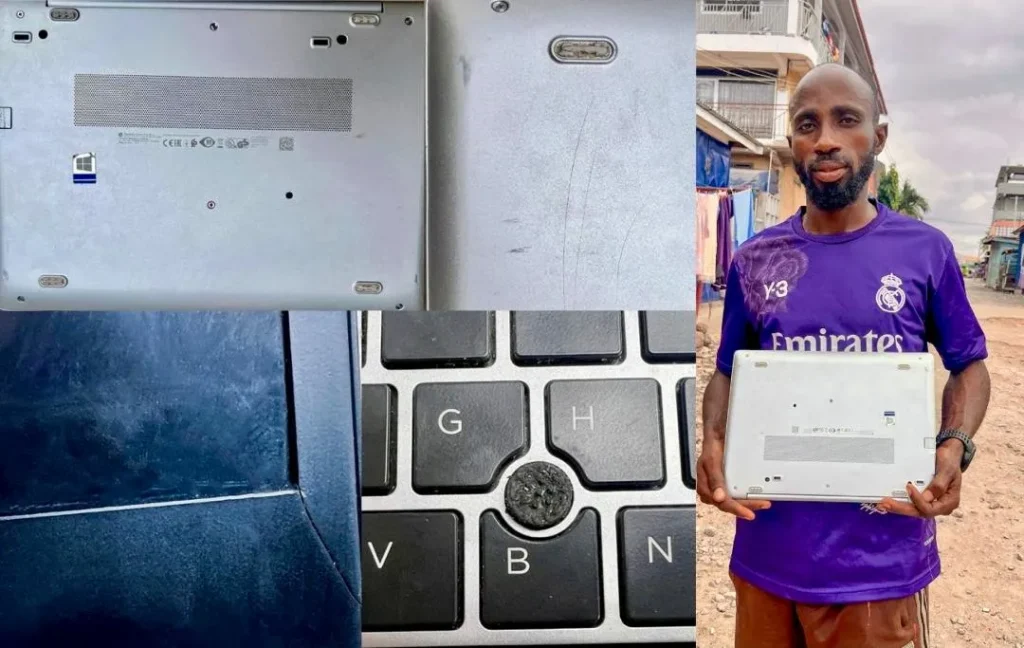
The Case of Patrick Dafeamekpor: GH₵3,800 Approved for New Laptop, Given Broken Used Machine
Mr Patrick Dafeamekpor, a deaf graphic designer who relies on digital technology for communication and work, put in a request for a laptop and other equipment.
After being asked to revise his request twice, the Disability Fund Management Committee records show that GH₵3,800 was finally approved for a new laptop.
Instead of procuring a new machine from an accredited distributor as required by law, the Assembly delivered a heavily worn, second-hand HP EliteBook. He received no receipt and no balance from the approved amount.
Inspection of the delivered machine by DisabilityNewsGH.com revealed:
- Cracked and Defaced Chassis: A visible structural crack and heavy scuffs along the casing.
- Stripped Base Grips: All four anti-slip rubber foot-pads were missing, leaving the base unstable.
- Unresponsive Keyboard: Multiple keys were non-functional, preventing basic typing and communication.
According to the system properties, the machine is an HP EliteBook with Intel Core i5 8th Gen, 8GB RAM and 256GB SSD.
While the specification on paper could handle basic graphic design, the unit delivered was a 7-year-old model released in 2018, heavily worn and partially defective, with an open market value of GH₵1,200 to GH₵1,500 in its current condition. It is not new, unused or of the most recent model as required by Act 663.
Mr Dafeamekpor further stated that the machine struggles with updates and modern design software requirements, a common problem with aged second-hand devices that lack warranty, active manufacturer driver support and sufficient storage for CorelDRAW, Photoshop and Illustrator scratch files.
For a graphic designer who relies on up-to-date software for client work, this renders the device obsolete, insecure and unsustainable.
According to him, the machine currently lies unused, unable to serve the purpose for which it was approved.
The Assembly has not accounted for the balance of over GH₵2,000 from the approved GH₵3,800.
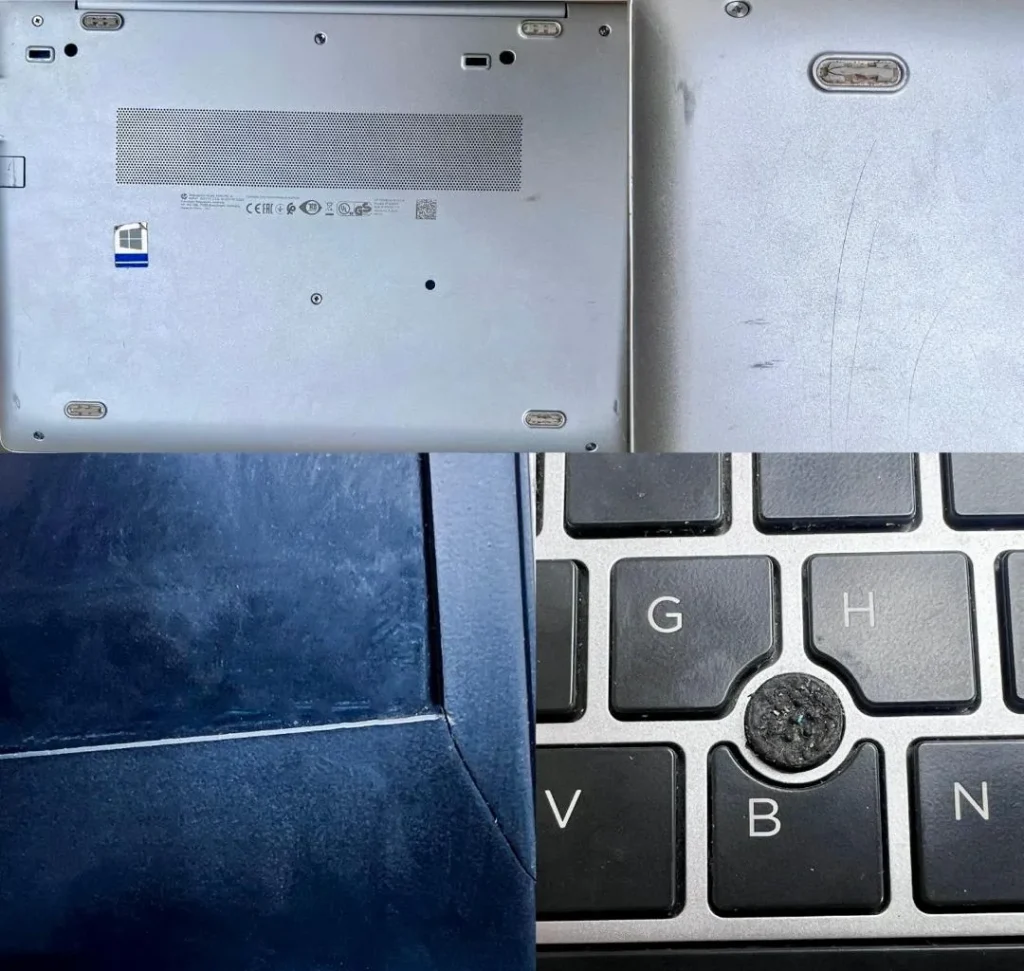
Photo Description: The severely damaged parts of the used, broken laptop altogether in one shot.
ASHMA’s Procurement Double Standard
WHAT ASHMA CLAIMED IN ITS REJOINDER:
“Procurement of second-hand equipment breaches the Public Procurement Act, 2003 (Act 663)… Goods shall be new, unused, and of the most recent models… procurement of used equipment with public funds is not in compliance with the law and will attract audit queries.“
THE FACTS:
If procuring second-hand equipment attracts audit queries, why did the Assembly in the same May 8, 2026 disbursement cycle procure a cracked, second-hand laptop for Patrick Dafeamekpor while absorbing a budget meant for a new machine?
Why was Act 663 strictly enforced to deny Mr Appiah a printer, but ignored to deliver defective used equipment?
For Mr Appiah who WANTED a used printer, they said “we don’t buy used.” For Patrick who was approved for a BRAND NEW laptop, they bought used.
A Pattern of Missing Balances
- Mr Anthony Kwaku Appiah: Approved GH₵5,000 for a commercial printer. Item delivered worth GH₵2,300. GH₵2,350 unaccounted for after a 7 percent deduction.
- Mr Patrick Dafeamekpor: Approved GH₵3,800 for a brand-new laptop. Delivered broken second-hand machine valued at GH₵1,200 to GH₵1,500 and currently unusable. At least GH₵2,300 of the approved amount remains unaccounted for.
- The 39-Beneficiary List: An intercepted internal document revealed a flat 7 percent deduction from cash and equipment grants, siphoning GH₵9,037 from a single disburment cycle.
What The Guidelines Actually Say
The Disability Fund is 5% (formerly 3%) of the District Assemblies Common Fund (DACF) released quarterly to each Assembly. While the 5% is standard, the actual cedi amount differs per Assembly depending on its Internally Generated Fund and other parameters.
What is uniform, however, is the principle: the amount approved must be adequate to serve the purpose for which it was requested.
Our investigation reveals that in many of the cases in Ashaiman, beneficiaries are given half or a quarter of their requests. On top of that, the Assembly deducts an illegal 7% as tax, even when the remainder cannot serve its purpose. In the end, the money goes to waste because it does not solve the person’s needs.
Per the guidelines, the Assembly’s Procurement Officer, in the company of two members of the Fund Management Committee, is supposed to procure the items for the beneficiaries, and more importantly, the support MUST serve the intended purpose.
How Can GH₵3,800 Buy A New Graphic Design Laptop?
This raises a bigger question that indicts the whole process.
On the Ghanaian market today, a brand-new laptop capable of running CorelDRAW, Photoshop and Illustrator with speed – Core i5, 8GB to 16GB RAM, 512GB SSD – sells from GH₵5,500 to GH₵9,000.
A brand-new machine at GH₵3,800 is only an entry-level office laptop with Celeron or Core i3 and 4GB RAM, which freezes under heavy graphic files.
So why did the Fund Management Committee approve GH₵3,800 for a graphic designer if it cannot buy a fit-for-purpose machine?
And if GH₵3,800 was all the Assembly could afford, why did it not procure a brand-new entry-level machine worth GH₵3,800 from an accredited shop with warranty and receipt, instead of a scuffed, broken second-hand machine valued at GH₵1,200?
The answer points to two violations:
First, inadequate assessment. Approving an amount that cannot serve the intended purpose violates the Disability Fund Guidelines, which state that support must be adequate and must serve its purpose.
Second, diversion of value. Even that inadequate GH₵3,800 was not applied. The difference of at least GH₵2,000 between the approved amount and the market value of the used machine delivered remains unaccounted for.
Even if GH₵3,800 was inadequate, the law does not permit the Assembly to substitute it with a used item worth GH₵1,200. It permits only one thing: to procure a new item up to GH₵3,800 with full documentation.
DisabilityNewsGH.com has also obtained fresh evidence on ASHMA’s sudden U-turn on Mr Appiah’s faulty printer after weeks of inaction. Full details in our next publication tomorrow.
DisabilityNewsGH.com reiterates its call on the Auditor-General, the Office of the Special Prosecutor (OSP) and the Economic and Organised Crime Office (EOCO) to launch a forensic audit into all PWD Common Fund procurements and disbursements by the Ashaiman Municipal Assembly.
SOURCE: DisabilityNewsGH.com