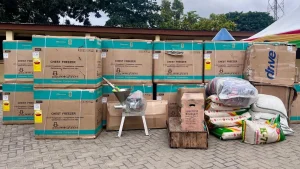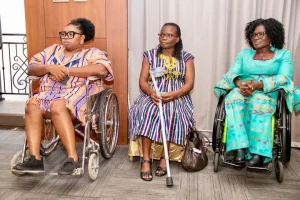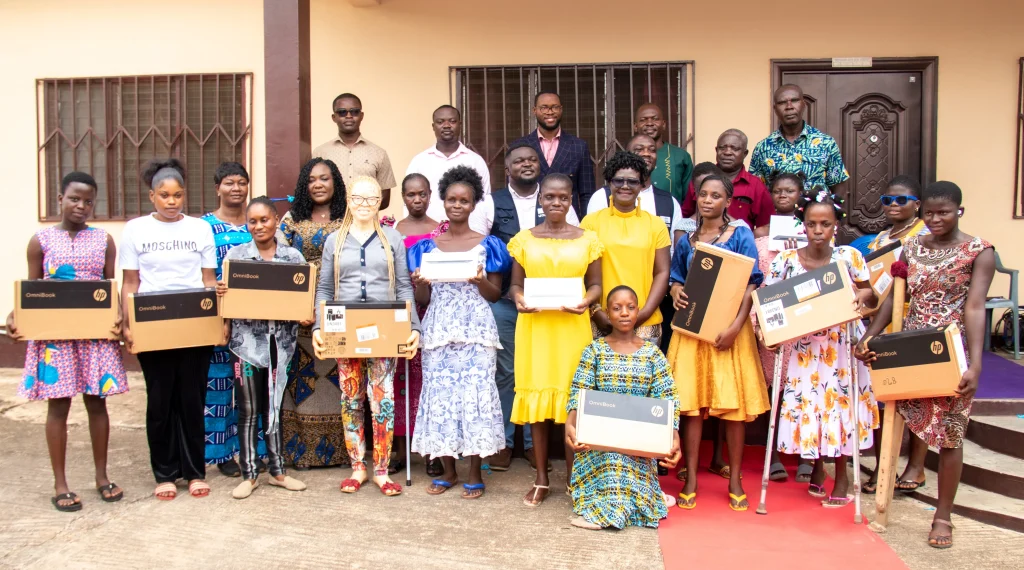
To improve the economic prospects of women with disabilities, 13 young female entrepreneurs have received specialised laptops and tablets to strengthen their digital capabilities and expand their businesses within the digital economy.
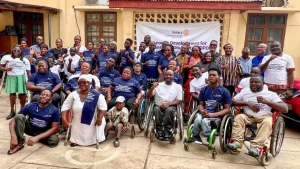
The presentation ceremony, held on 16 April at the Henry Djaba Memorial Centre in Somanya, Yilo Krobo District of the Eastern Region, marks a significant milestone of the Digital Access and Rural Empowerment (DARE) Project.
The initiative is a collaborative effort among UNESCO, the University of Ghana Business School (UGBS), and the Ghana-India Kofi Annan Centre of Excellence in ICT (GI-KACE), funded by the Mastercard Foundation, with Inclusive Tech Group serving as the implementing agency.
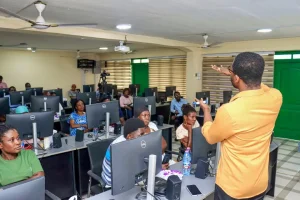
The donation follows an intensive entrepreneurship and ICT training programme conducted between June and November 2025 for 100 women with disabilities.
While all participants gained skills in business management, financial management, branding, and digital marketing, the 13 participants were selected based on their exceptional performance and their immediate potential to scale existing businesses.
The recipients included five women with visual impairments, two with cerebral palsy, two deaf, one with albinism, and three with physical disabilities. To ensure full accessibility, the devices were fitted with screen readers and other specialised applications tailored to each user’s specific needs.
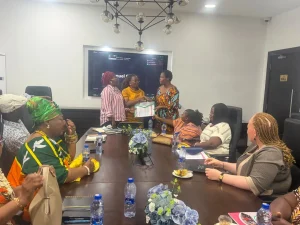
Delivering a goodwill message on behalf of UNESCO Ghana, Project Officer in charge of Capacity Building and Digital Integration Mr. Richmond Atta-Williams, highlighted the DARE Project as a deliberate response to the digital and economic exclusion often faced by women with disabilities.
He noted that digital skills are essential for participation, productivity, and dignity in the world of work. Mr. Atta-Williams revealed that plans are already underway to expand the programme to the Bekwai and Gushegu Municipalities, reaching an additional 200 participants.
He further emphasised that sustaining this impact requires collective responsibility. He called on families and caregivers to ensure the devices are used as tools for productivity, whilst urging government and institutional stakeholders to strengthen coordination across the education, social protection, and labour sectors.
He concluded by commending the consortium partners and expressing deep gratitude to the mastercard foundation, whose investment remains the backbone of the initiative, while calling for expanded funding to ensure no woman with a disability is left behind in Ghana’s digital transformation.
Supporting this vision, Mr. Joseph Aboagye, Project Coordinator for Inclusive Tech Group (ITG), noted that technology is a powerful equaliser.
He stated that the donation is only one step in a broader journey, as ITG remains committed to ensuring participants are equipped with the skills, confidence, and online safety awareness needed to maximise the use of the devices.
He encouraged the participants to view the laptops as gateways to their ambitions, builders of solutions, and tools to shape their own futures.
In a significant moment of advice, the Yilo Krobo District Director of the National Commission for Civic Education (NCCE), Madam Henrietta Glikpo, cautioned the participants against selling or giving out the devices.
She reminded them that the gadgets were programmed specifically for their exclusive use and should be guarded as lifelong assets for their empowerment.
The event was attended by the District Directors for the Department of Social Welfare and the National Youth Authority, as well as leaders from the local disability community.
The participants expressed deep appreciation for the gesture, which they described as an unexpected boost that would enable them full participate in the digital society.
SOURCE: DisabilityNewsGH.com