In what has been described as a milestone for participatory governance, disability groups in the Ga West Municipality have successfully moved from passive recipients of aid to active monitors of state resources.
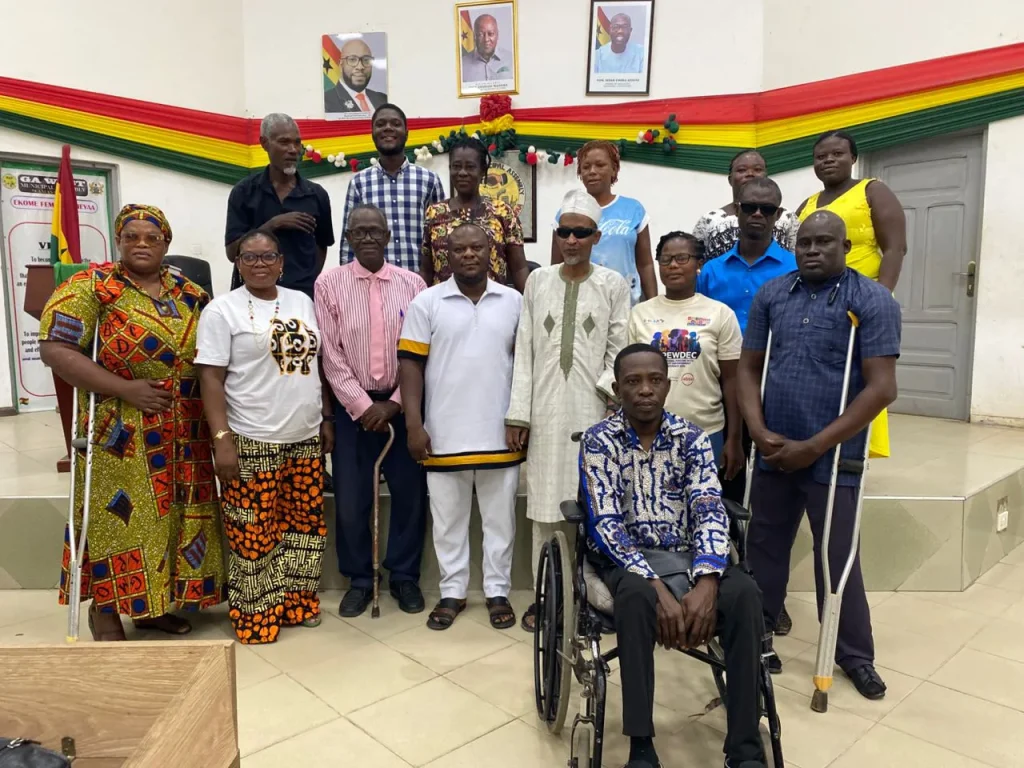
At a high-stakes engagement held on February 13, 2026, at the Ga West Municipal Assembly Hall, representatives of the disability community sat face-to-face with the District Assembly Common Fund (DACF) Committee to demand transparency and inclusivity in the management of the 3% Disability Fund.
The meeting, organised by the ABAK Foundation in partnership with Sightsavers, brought together the “Big Three” advocacy groups: the Ghana Blind Union (GBU), the Ghana Society of the Physically Disabled (GSPD), and the Ghana National Association of the Deaf (GNAD).
The engagement opened with an institutional briefing by the Social Welfare Director, Mrs. Evelyn Nanbigne, who clarified the fund’s guidelines, application vetting processes, and the committee’s legal oversight responsibilities.
However, the session took a decisive turn when Ghana Federation of Disability Organisations (GFD) executives demanded access to disbursement data spanning 2017 to 2024.
While past records were not immediately available, the Committee took the unprecedented step of releasing a PDF report on the 2025 disbursements.
This gesture was hailed as “historic” by the attendees. For years, disability groups had complained of systemic exclusion from financial documentation, often left in the dark regarding how much was being disbursed and to whom.
“This is the first time in a long while that we have seen actual figures,” one executive remarked, noting that seeing the data is the first step toward building institutional trust.
Beyond financial accountability, the meeting exposed critical gaps in the Assembly’s accessibility framework.
A major highlight was the absence of a professional sign language interpreter at the municipal level, a barrier that effectively silenced representatives from the Ghana National Association of the Deaf (GNAD).
Recognising this as a violation of inclusion principles, the Assembly pledged to escalate the matter for urgent action.
Gender inclusivity also emerged as a non-negotiable priority. Stakeholders reached a consensus that, in alignment with national disability fund guidelines, at least one female representative must serve on the DACF Committee.
This move is intended to ensure that the unique challenges faced by women with disabilities are prioritised in funding decisions.
The engagement concluded with several high-level commitments from the Municipal Assembly:
1. Full Transparency: The immediate release of the 2025 disbursement report to all disability groups.
2. Institutionalised Dialogue: The establishment of structured, periodic engagements between the disability community and the DACF Committee.
3. Communication Access: The provision of a sign language interpreter for all future municipal engagements.
4. Gender Parity: A formal assurance of female representation on the management committee.
The success of the Ga West engagement – catalysed by the support of the ABAK Foundation and Sightsavers – is being viewed as a potential blueprint for other municipalities across Ghana.
As one participant aptly summarised: “This is how inclusion begins – with dialogue, with accountability, and with a commitment to do better.”
By demanding a seat at the table and access to the ledger, the disability groups in Ga West have proven that transparency is not an optional courtesy, but an essential pillar of effective governance.
By Castro Kofi Appiah
SOURCE: DisabilityNewsGH.com