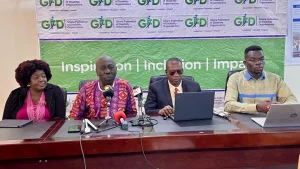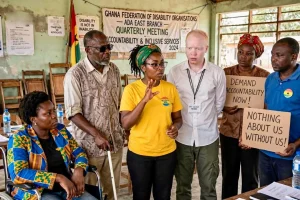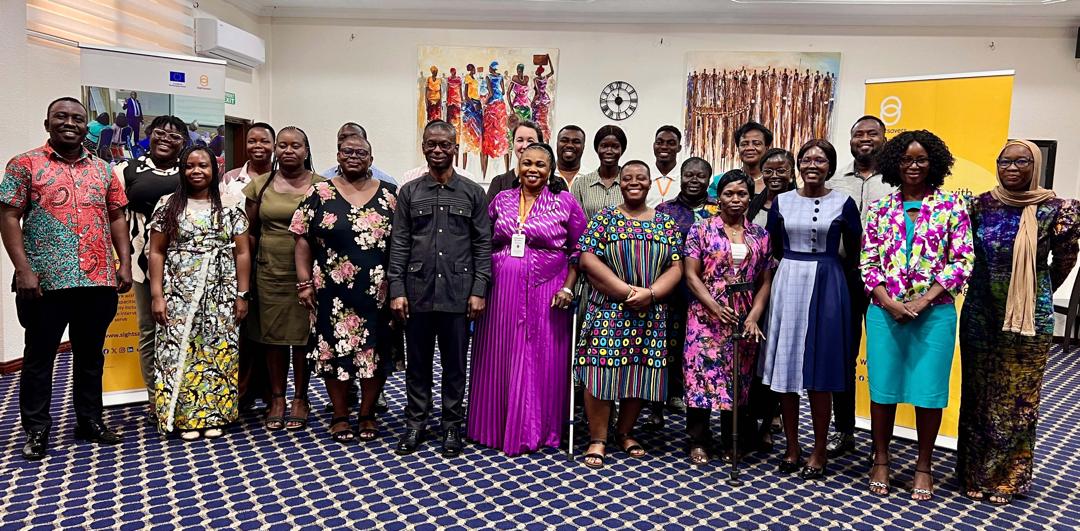
A recent capacity-building workshop has ignited a powerful call from Ghanaian women’s rights advocates for intensified public education on disability inclusion.
Many participants confessed to a surprising lack of knowledge in the field, realising their understanding of inclusion had largely been confined to women and girls, often overlooking the distinct needs and systemic exclusion faced by women with disabilities.
The two-day Disability Inclusion Training for Women Rights Organisations, co-funded by Sightsavers and the European Union, took place on November 18 and 19, 2025, in Accra. Led by the Women with Disabilities Development and Advocacy Organisation (WODAO), the training aimed to strengthen the capacity of women’s rights groups to effectively include and advocate for women with disabilities.
Covering topics such as disability definition, positive terminologies, gender and disability policy frameworks, and accessibility approaches, the workshop proved to be a profound eye-opener, exposing critical gaps in existing advocacy.
Madam Deborah Tawiah Akakpo, Head of Programme for the Gender Studies and Human Rights Documentation Centre, articulated her transformation. “Prior to coming here, I thought I knew what inclusion meant,” Madam Akakpo stated. “Then I got to realise that my inclusion has been more towards a gender inclusion, but not to the specific focus on persons with disabilities.”
She emphasised how the training not only clarified appropriate language but also illuminated the pervasive exclusion of persons with disabilities across systems, legal frameworks, and programmes.
Madam Akakpo highlighted how laws often broadly assume all women are covered, yet fail to consider the unique requirements of women with disabilities.
Citing the Affirmative Action Law, she suggested, “it would have been good if we could say we are allocating 2% of the 30% that we are fighting for to persons with disabilities,” arguing this would ensure genuine inclusion rather than disability being an “afterthought.”
She further called for a broader understanding of “gender,” stressing it encompasses various vulnerabilities, including the elderly, boys, or children, depending on circumstances, rather than solely women.
“What we forget is that gender is not just about women but it’s looking at vulnerabilities and addressing those vulnerabilities,” she noted, underscoring the need for intentionality.
Madam Akakpo’s personal commitment to this expanded understanding is firm. “There are 1001 people who need to know what I’ve learnt in these past two days. When I go back, I’m going to do a step-down training for the staff,” she affirmed, advocating for “a lot more public education, using every form of medium.”
Dora Mochiah, Programmes Officer for the Forum for African Women Educationalists (FAWE), echoed the sentiment, noting that while their work often focused on gender, disability inclusion was previously a “little component.”
Madam Mochiah stressed the necessity for a “deliberate effort” to ensure persons with disabilities are consciously included in all daily activities and engagements, alongside women, girls, boys, and men.
A particularly impactful lesson for her came from a speaker who highlighted that “anyone can experience some form of disability anytime, so today it might not be you but you could get a disability tomorrow.” This, she said, underscores the importance of being “conscious and deliberate to create room” for persons with disabilities.
She concluded that widespread awareness would enable organisations to integrate disability inclusion into planning, budgeting, and even venue choices.
Mr. Mohammed Abdul-Razak, Social Inclusion and Advocacy Manager at Sightsavers, expressed confidence in the workshop’s impact. “You can see that some of them actually raised very pertinent issues that but for this workshop, they wouldn’t have actually reflected on; which is the fact that they sometimes advocate for gender and they actually forget that it is intertwined with disability,” he observed, noting a shift from a “unilateral understanding of gender to include all sorts of disability.”
He also highlighted that participants were now ‘gearing towards standalone inclusion policies,’ a significant step, because previously ‘disability issues were actually getting missing’ within general policies that failed to adequately address specific disability needs. He added that some participants ‘really got exposed to the legal basis behind some of the issues of disability.’
He further affirmed that this deepened understanding reinforces the urgent need for expanded public education campaigns, including training for media professionals to assist with the call for inclusion in all facets of society.
SOURCE: DisabilityNewsGH.com