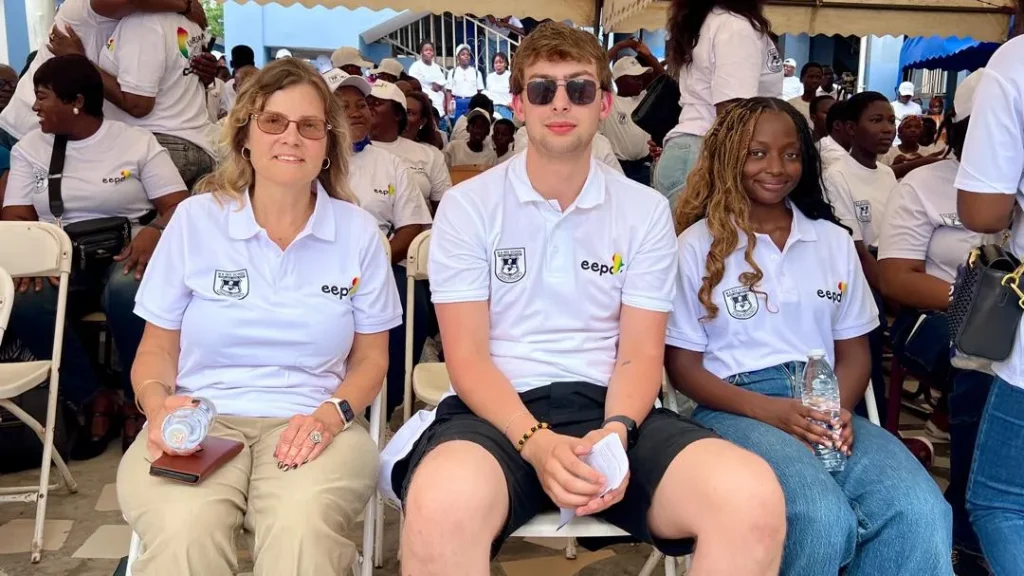
A team of international interns from the University of Vermont’s College of Nursing and Health Sciences (CNHS) and Duke University – including an Obama Voyager Scholar, has partnered with Ghana-based NGO, Enlightening and Empowering Persons with Disabilities (EEPD Africa), and the M & Bee School in Accra to launch an intensive community sensitisation campaign on “invisible disabilities.”
The initiative targets conditions that frequently go undiagnosed, misunderstood, and stigmatised in Ghanaian classrooms and homes.
This programme builds on existing partnership among institutions like the University of Vermont-USA, University of Cape Coast-UCC (Ghana) and Enlightening and Empowering People with Disabilities in Africa (EEPD Africa) which gave birth to the Disability Center and the International Certificate in Disability Studies Program at UCC, Ghana.
Dr. Komabu-Pomeyie, an internationally recognised disability rights advocate and a key figure in UVM’s partnership with UCC, and Founder of EEPD Africa, envisions these partnerships as transformative experiences that prepare CNHS students to become global citizens while strengthening their ability to serve communities in Vermont, Ghana, and beyond.
To her, it is time to bridge the gap between research in the universities and to empower the researched (PWDs) to be fully included and well resourced.
The initiative, part of UCC’s Global Disability Studies and the UVM’s Public Health, Equity and Advocacy Minor called (HSCI 1993: Public Health, Disability, and Intercultural Connections), taught by Dr. Komabu-Pomeyie aims to dismantle the myths surrounding learning disabilities and public health.
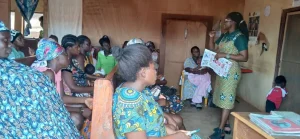
The campaign was officially launched on July 3, 2026, at the M & BEE School in Nii-Boi Town with a mini-durbar for learners, teachers, and parents, followed by a community float through Nii-Boi Town, Akweteyman and Lapaz.
Beyond the Stigma: PWDs as Visionaries
Many children struggle with learning disabilities – such as dyslexia, dysgraphia, or Attention Deficit Disorder (ADD) – which are not immediately visible.
Unlike physical disabilities, these conditions are often mislabeled by parents and teachers as laziness, academic dullness, or even spiritual affliction.
Madam Mabel B. Gbedemah, founder of the M & BEE School and an alumna of the University of Cape Coast, from the (International Certificate in Disability Studies Programme at UCC.) shared her personal journey of navigating life with a learning disability.
“For too long, children who process information differently have been mocked, bullied, and labeled as ‘dull’ or ‘lazy’,” Madam Gbedemah explained during the durbar. “They often know the answers in their minds but struggle to express them on paper. When we force these children to perform exactly like their peers without the right psychological assessments, we are essentially asking a fish to climb a tree.”
Madam Gbedemah further emphasised the need to acknowledge the hidden talents within individuals with invisible disabilities.
Citing examples like Albert Einstein and Temple Grandin, she highlighted how many individuals with these conditions are visionaries, great thinkers, scientists, and engineers.
Her vision is to establish a specialised school exclusively for individuals with invisible disabilities, staffed by specially trained facilitators who understand their unique language, fears, and potential. “They hold the keys to reset Ghana,” she powerfully declared.
Global Perspectives for Local Impact
The UVM interns, Lucas Zahed (Undergraduate student) and Laura Terry (Master’s Degree student), are actively engaged in the three-week internship with EEPD Africa.
Laura Terry, a Vermonter with extensive experience as a shared living provider for young adults with intellectual disabilities and traumatic brain injuries, is also an instructor at Vermont State University and a Master Reiki Practitioner.
Her work at UVM includes developing public health policy information sheets addressing healthcare needs for individuals with intellectual and developmental disabilities, findings which she plans to present to Vermont legislators and at the 2026 Conference of The Association for Persons with Severe Handicaps (TASH).
The internship for both students includes:
* Community Sensitisation: Training teachers and parents on early identification of learning disabilities.
* Capacity Building: Engaging health facilities and workers in rural communities to improve disability-inclusive service delivery.
* Assistive Support: Partnering with Free Wheelchair Mission (USA) to donate wheelchairs to those in need.
* Assistive Support: Partnering with Free Wheelchair Mission (USA) to donate wheelchairs to those in need.
A Call for Inclusive Education
Dr. Reuben Adek, Project Manager at EEPD Africa, emphasised that the Ghanaian education system must move beyond a narrow reliance on “A-4 sheets” and formal examinations as the only metric for success.
“We must appreciate the diversity of our learners,” Dr. Adek stated. “Some children are gifted in handicrafts, sports, or technical arts. It is time we stop parents and teachers from making toxic comparisons that make children who struggle academically feel inferior. Beating a child for poor grades or encouraging teachers to do so is not a solution – it is a violation of their rights.”
Dr. Adek further urged the public to recognise that invisible disabilities, while incurable, are highly manageable if identified early.
Early identification, he noted, can prepare these children for greater success, enabling them to excel in diverse disciplines like research science, software engineering, and architecture, where strengths such as pattern recognition, deep focus, and visual thinking are highly valued.
EEPD Africa continues to serve as a critical bridge in Ghana and beyond, facilitating scholarships, advocating for accessible public infrastructure, and educating institutions on the legal protections afforded to PWDs under the Human Rights Act and national policies.
As the campaign continues, the message from the organisers is clear: invisible disabilities are not a sign of a lack of potential.
With proper assessment, inclusive teaching methods, and a shift away from cultural stigma, these children can transition from being “targets” of ridicule to becoming the next generation of innovators and leaders.
SOURCE: DisabilityNewsGH.com

Dear Sir/Madam,
Greetings.
I write to inquire about the Disability Studies. I am Apostle Dr. J. Aaron Wright, Sr. of the National Commission on Disabilities – NCD. Kindly send me information on the Course at the University of Cape Coast in Ghana. I will like to do the Program online.
Please contact Dr. Sefakor at Email: dep.ucc.edu.gh
Tel: +233 (507652689, 332091697, 245698750.
Dear Sir/Madam,
Greetings.
I write to inquire about the Disability Studies. I am Apostle Dr. J. Aaron Wright, Sr. of the National Commission on Disabilities – NCD. Kindly send me information on the Course at the University of Cape Coast in Ghana. I will like to do the Program online.