UPDATE — Feb 19, 2026: Following this report, the UCC Resource Centre has recalled Augustina’s broken recorder for repair. We have also offered the University an official Right of Reply, which we will publish in full once received.
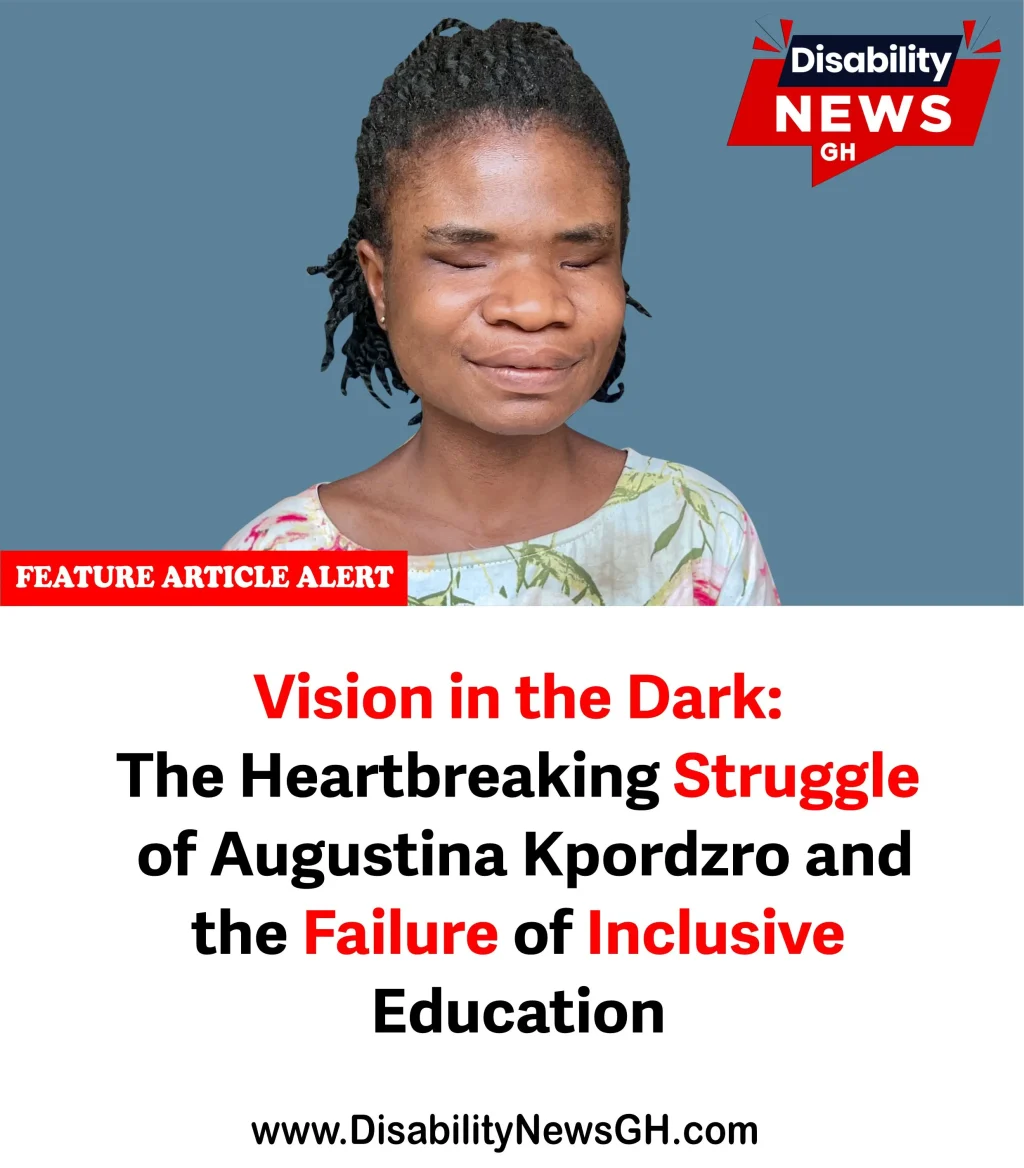
Augustina Kpordzro may be without sight, but she has never been without vision. In the quiet village of Kisi, in the Central Region of Ghana, she spent nearly a decade nurturing a dream that many would have called impossible: she wanted to be a lawyer.
But for Augustina, the most painful part of her journey isn’t being totally blind; it is watching her future gradually fade away, not because of her disability, but because of the cold hands of poverty.
A Decade of Waiting
Augustina completed Ghana National College in 2015. While her peers moved on to build lives and careers, Augustina’s life came to a standstill. For nine long years, from 2015 to 2024, her aspirations were held hostage, tied to an SHS certificate she couldn’t even collect because of outstanding fees. For almost ten years, she was “educated for the shelf,” waiting for a door to open.
The silence was finally broken in 2024 by Daniel Akebe Amoah, a CorpsAfrica/Ghana volunteer. Recognising the sharp intellect behind Augustina’s sightless eyes, Daniel did what the system had failed to do: through his advocacy, CorpsAfrica/Ghana cleared her SHS arrears and paved her way to the University of Cape Coast (UCC), with the immense support of Dr. Ivy Ama Kpodoe.
In 2024, nearly a decade after she had first completed Senior High School, and years after her peers had already graduated and entered the professional world, Augustina finally entered the ivory tower. She was offered a Bachelor of Education, a departure from her dream of Law, but she accepted it with the grace of a woman who knew that a late start is better than no start at all.
The UCC Nightmare: Accessibility as a Myth
However, the “Citadel of Learning” soon proved to be a fortress of exclusion. What was supposed to be a day of fulfillment turned into a day of sorrow. The university made zero “reasonable accommodations” for Augustina.
Even today, she faces staggering physical barriers: three of her core lecture halls are located on the upper floors of storey buildings with no lifts, making mobility a daily hazard.
Her living conditions are equally daunting. Augustina shares a congested hostel room with five other ladies. Among them are three sighted students and two who are partially sighted; Augustina is the only one who is totally blind.
With six people’s baggage and personal effects crowded into one space, the room has become a labyrinth that is exceptionally difficult for a totally blind student to navigate safely.
The most egregious failure, however, was in the classroom. The University’s Resource Centre provided her with a single audio recorder, her only lifeline to the lectures. Tragically, it broke down before any meaningful learning could start. It has not been fixed; it has not been replaced.
Imagine being blind in a lecture hall, unable to see the board, unable to read handouts, and stripped of the only device that could record the lecturer’s voice.
During that first year, Augustina had no smartphone and, crucially, no laptop—tools she still lacks even as she restarts Level 100 today.
Forced to attend lectures like every other student, yet without the basic means to capture or process information, she was essentially a blind student left to drown in a sighted world. No wonder she failed two papers and missed four ‘Internal Credits’ (ICs).
Shockingly, she didn’t even know what an “IC” was—a staggering proof that the university failed to communicate its basic academic requirements in an accessible format. Instead of offering a resit, UCC took a punitive path: they forced her to reapply and restart Level 100.
The Math of Inequality: A Shrinking Future
In January 2026, at the age of 34, Augustina is back at the starting line. But a university “reset” doesn’t stop the clock of life. By the time Augustina completes this four-year course and her mandatory year of National Service, she will be 39 years old.
Given the hard reality of the labour market, she could easily be 42 or 43 before earning her first professional paycheck. This leaves her with a mere 17 to 18-year window before the mandatory retirement age of 60.
While her sighted peers have 40 years to build their careers, Augustina is being mathematically set up for retirement in poverty.
The Policy Debate: Extension vs. Salary
Augustina’s plight is a living case study for the debate surrounding the 1992 Constitutional Review. During recent consultations, suggestions were made to extend the retirement age for persons with disabilities to compensate for these systemic delays in education and employment.
However, the disability community is divided. Many argue that an extension is a “curse rather than a blessing,” as the physical toll of disability causes the body to weaken faster.
They are instead calling for PWDs to “Retire on their full Salaries” to ensure security without the strain of extra years of labour. Others propose a “Hybrid Model,” where an extension is optional, allowing those with sensory disabilities (like the blind) to work longer if they choose, while those with physical disabilities retire early on their salaries.
A Plea for Augustina: Let’s Light Her Path
As the policy debate rages on, Augustina is back in Level 100, unarmed for the battle ahead. Her mother is no more, and her aged father is unable to provide the support she needs.
While her benefactor, Daniel Akebe Amoah, has managed to provide her with a smartphone, it lacks the specifications and processing power to support the specialised accessibility apps required for her complex studies.
Augustina is essentially fighting a modern academic war with broken tools. We are appealing to the public, philanthropists, and NGOs to provide her with:
- A Laptop with Screen-Reading Software (JAWS/NVDA): This remains her most urgent need for research, assignments, and independent study.
- A Professional Digital Audio Recorder: To ensure she never misses another lecture due to the institutional failures of the past.
- A High-Spec Accessible Smartphone: An upgraded device capable of running advanced assistive applications that her current phone cannot support.
- Economic Support: Seed capital to start a petty business during vacations. This will allow her to raise funds to support her education rather than “idling” at home during the long breaks.
- Mentorship and Specialised IT Training: To ensure she masters the use of these assistive devices, giving her a competitive edge in the short 21-year working window she has left.
Augustina Kpordzro has fought for ten years just to sit in a classroom. Let us make sure that this time, the system doesn’t steal her vision and her future again.
Please send your donations to her benefactor on: 0595906090 (Akebe Daniel Amoah). May God bless you as you do this for the needy.
SOURCE: DisabilityNewsGH.com